Airport security rules are easy to underestimate when a trip starts in Thailand, especially if you have a connecting flight or are taking gifts and duty-free purchases home. A bottle that fits inside a cabin bag is not necessarily acceptable at a security checkpoint. The key distinction is between the size of the container, what it contains and which screening point you will pass through.
Thailand’s Civil Aviation Authority (CAAT) publishes guidance on liquids, gels and aerosols in hand luggage. It also published a newer screening notification in 2026. The guidance below is a planning checklist, not a substitute for the current airport and airline instructions for your itinerary.
Understand the standard 100 ml container limit
CAAT’s public passenger guidance describes liquids, gels and aerosols in cabin baggage as being limited to containers with a capacity of no more than 100 millilitres each. The container size matters: a large bottle holding only a small amount of liquid can still be rejected. Toothpaste, creams, perfume, drinks and many other everyday products count as liquids or gels for screening purposes.
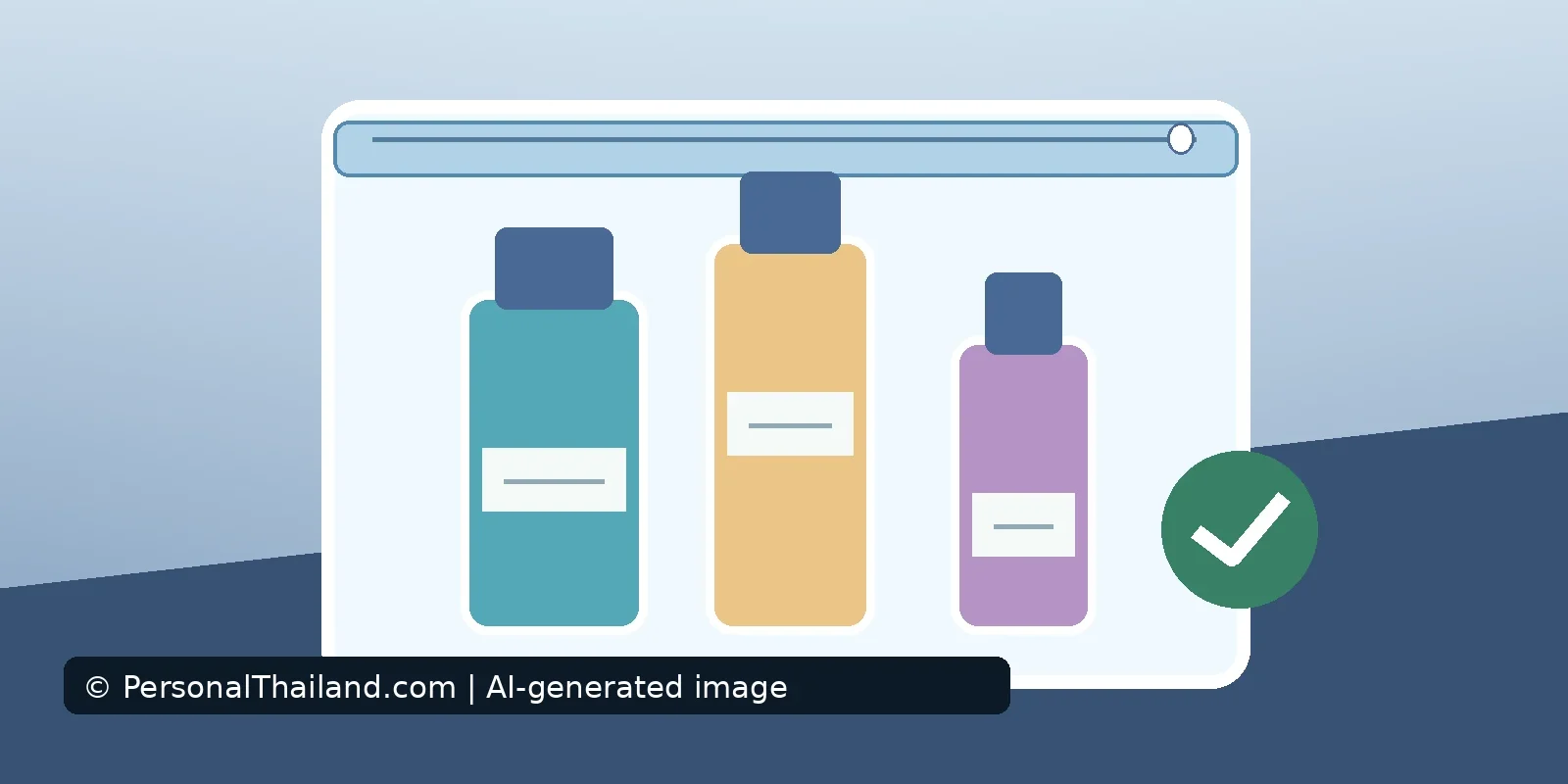
The same guidance calls for the permitted containers to fit in one transparent, resealable bag with a maximum one-litre capacity, generally one bag per passenger. Pack it where it can be presented at the checkpoint. Because screening practices can be adjusted, review the current CAAT notice and your departure airport’s instructions before travelling.
What belongs in checked baggage instead?
For standard toiletries that exceed the hand-luggage container limit, checked baggage may be the practical option, provided the item itself is permitted in the hold. Never assume all sprays, chemicals or batteries are allowed simply because they are packed in a suitcase: dangerous-goods rules are separate from the liquid-container rules.
Keep valuables, essential documents and permitted medication accessible. When an item has a safety classification — such as pressurized aerosols or flammable products — consult the airline’s dangerous-goods policy rather than treating the one-litre bag rule as blanket permission.
Medicines, infant supplies and special situations
CAAT’s aeronautical information guidance describes screening exceptions for reasonable quantities of necessary medicines and baby milk or food, with presentation at the checkpoint. In practice you may be asked to explain what you are carrying, show labels or supporting documents, or undergo additional screening. Requirements may vary by product and airport.
Keep medical liquids in their original labelled packaging if possible and check any controlled-medicine import or export restrictions separately. Do not use a medical exception as a way to carry ordinary cosmetic products in larger containers. If travelling with an infant or medical equipment, contact the airline before the day of departure.
Duty-free liquids and a connecting flight
A sealed airport shopping bag does not guarantee the item will pass every later security checkpoint. Rules and exemptions may depend on the airport, final country, airline, receipt and whether a tamper-evident bag remains unopened. Thailand’s aeronautical information publication describes conditions for duty-free liquid purchases and explicitly advises passengers to check the policy at their transit and destination airports.
Before buying a large bottle of perfume or another liquid after security, tell the shop about the full itinerary, including airport changes and separate tickets. Ask whether the product will be packed in an accepted security bag and retain the receipt. If the connection requires entering the country and re-clearing security, check that scenario specifically.
Practical packing routine for a smoother checkpoint
The night before flying, put small toiletries in a transparent bag, move oversized nonessential items out of hand luggage and check your airline’s baggage rules. Keep liquid medicines and infant supplies accessible for screening. Remove water bottles or other drinks that exceed the permitted capacity before reaching security, unless the specific screening procedure allows otherwise.
Allow additional time if you have a complex itinerary. The rules for cabin-bag size and weight, electronic devices and dangerous goods are different issues and should be checked separately with the carrier. Your departure airport may also use different screening equipment or instructions at particular checkpoints.
Check the latest official rule, not a 2007 notice
This post originally quoted the measures introduced in June 2007. Those quotations should not be presented as new rules today. CAAT has published subsequent guidance, including an in-force notice in 2026 dealing with screening of liquids, gels and sprays. Its detailed legal text should be checked directly when a precise exemption matters.
For most travellers, the safe approach is simple: keep routine liquid containers small, keep the transparent bag ready, carry documentation for special medical needs and verify rules again whenever a journey includes another country or security checkpoint.