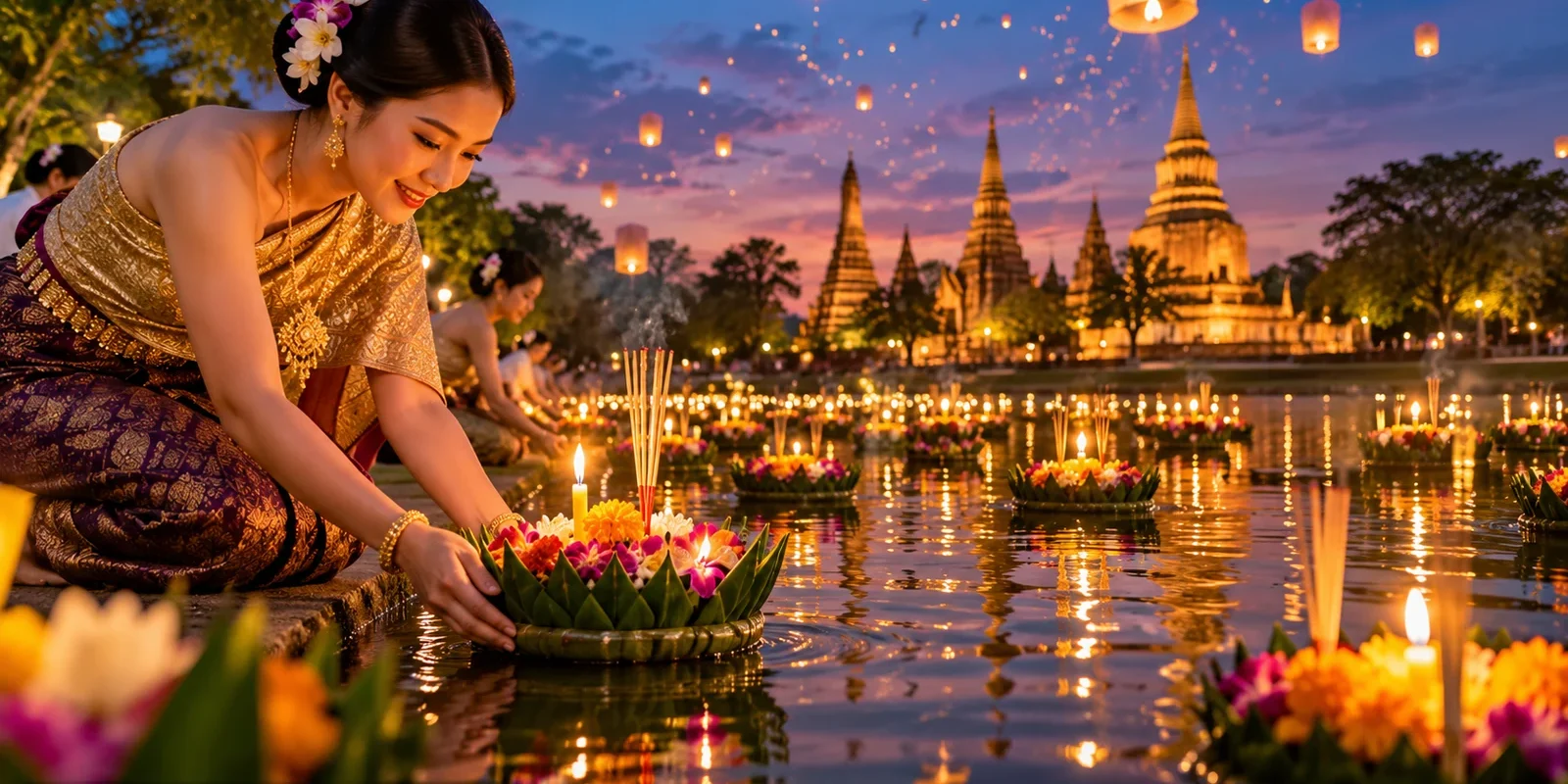
On one evening of Thailand’s lunar calendar, waterways can glow with candlelit offerings. People gather beside rivers, ponds and canals to float small decorated rafts called krathongs. This is Loy Krathong, one of Thailand’s most recognisable traditional festivals. For visitors, its beauty is easy to appreciate; understanding the meaning behind the lights makes the occasion more memorable.
What does Loy Krathong mean?
The word loy means to float, while a krathong is the small decorated vessel placed on the water. Traditional krathongs often use banana-stalk or banana-leaf materials with flowers, a candle and sometimes incense. The Tourism Authority of Thailand describes floating a krathong as a way to show gratitude to waterways and to express regret for pollution or misuse of water.
Many people also treat the act as a personal moment of reflection: an opportunity to let go of misfortune or negative experiences and make a hopeful wish. Meaning varies among families and communities. A visitor does not need to adopt a particular religious belief to participate politely.
Is Loy Krathong a Buddhist holiday?
Loy Krathong takes place in a predominantly Buddhist society, and Buddhist ideas and local beliefs may be part of the celebration. But it is more accurate to describe it as a Thai cultural and traditional festival rather than a single uniform Buddhist rite. Customs differ by area, and accounts of the tradition’s earliest origin are not universally agreed upon.
You may hear stories linking the festival to Sukhothai, to older rituals or to respect for the water goddess Phra Mae Khongkha. These are important parts of the festival’s cultural storytelling, but should not be presented as an uncontested historical fact about one exact founder or starting date.
When is Loy Krathong celebrated?
Loy Krathong is traditionally associated with the full moon of the twelfth month of the Thai lunar calendar, usually falling in November on the international calendar. The Gregorian date changes each year. Cities may hold associated markets, performances and cultural programmes before or after the principal evening.
Always check the current year’s announcements from the local authority or the Tourism Authority of Thailand. Older event schedules, fireworks programmes and road-closure notices are not reliable planning guides for a new year.
What happens on the night?
In many places, families and groups walk to an authorised waterfront venue, buy or make a krathong, light the candle and carefully set the decorated float on the water. The atmosphere can range from quiet and personal to crowded and festive. You may also encounter food vendors, traditional performances or organised displays, depending on the location.
The most memorable part is often the pause before release, when people reflect on the water and what they hope to leave behind. It is a tradition best experienced with patience rather than rushing through a photo opportunity.
Where can you experience the festival?
The Tourism Authority of Thailand describes distinctive traditions in different regions, including Sukhothai, Tak, Samut Songkhram, Chiang Mai and Bangkok. These locations offer different settings and local customs. Chiang Mai’s Yi Peng lantern culture is often mentioned at the same time, but the ceremonies and their organisation are not identical everywhere.
For a simpler experience, look for a local, officially designated celebration near your accommodation. You do not need to travel to a famous location to appreciate the meaning of the festival. Confirm transport and accessibility independently; large celebrations can affect traffic and pedestrian access.
Celebrate without harming the water
Loy Krathong is closely associated with respect for waterways, so leaving harmful waste behind works against the spirit of the occasion. Choose a small offering made from locally approved natural materials where permitted, avoid plastic decorations, and follow the venue’s instructions. Natural materials still create waste and are not appropriate for every river, pond or ecosystem.
Some communities organise symbolic floating areas or alternatives to releasing objects into open waterways. If you have the option, consider a shared krathong or a non-floating display to reduce waste. Never release sky lanterns where they are prohibited or where they create a fire or aviation risk; rules differ by location.
Etiquette for visitors
- Respect people who are praying or making wishes; ask before taking close-up photos.
- Use only designated access points and do not climb over barriers to reach the water.
- Keep children away from unguarded edges, and take care around candles.
- Do not throw packaging or leftover flowers into canals or rivers.
- Follow local advice about crowd movement, weather and temporary closures.
A festival worth experiencing thoughtfully
Loy Krathong is not simply a picturesque floating-candle spectacle. Its appeal lies in how beauty, gratitude, community and reflection come together. Whether you make a small offering or quietly watch from the riverbank, taking time to understand the custom is the best way to appreciate the evening.