Can you take a bottle of water through security at a Thai airport? The answer depends on the size of the container, what it contains and where you are in the airport. The rule is not a total ban on water aboard aircraft, but a restriction on liquids, aerosols and gels passing through passenger screening.
Thailand introduced a widely discussed 100-millilitre cabin-baggage rule on 1 June 2007. The original version of this article reacted to the change at the time. The historical start date is genuine, but the most important information for today’s traveller is the currently published screening guidance. Suvarnabhumi Airport’s updated liquids, aerosols and gels guidance cites a Civil Aviation Authority of Thailand announcement dated 5 March 2026.
What is the 100 ml rule in Thailand?
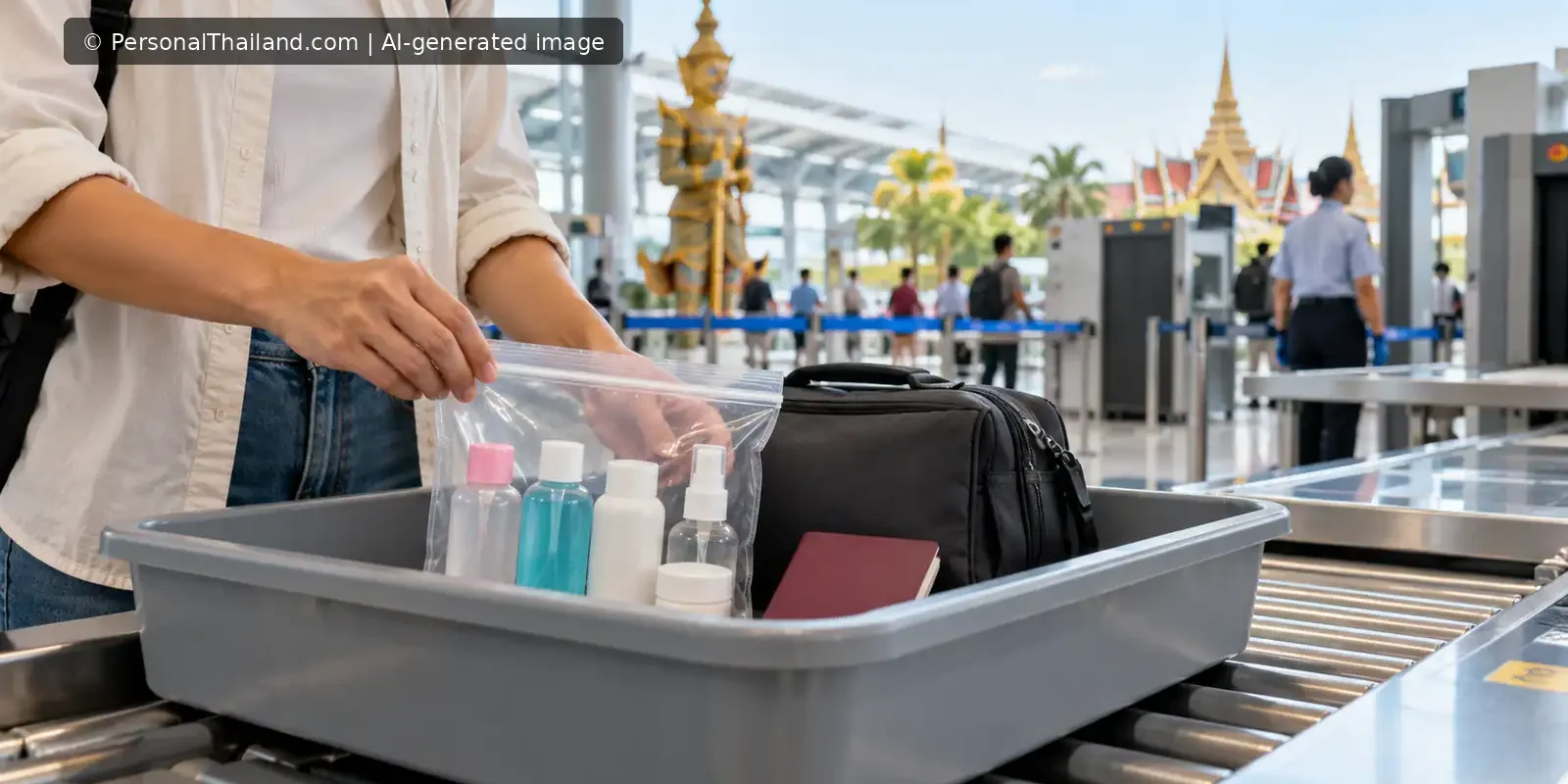
Ordinary liquids, aerosols and gels in cabin baggage must generally be in individual containers of no more than 100 ml capacity. The containers go together in a transparent resealable bag with a total capacity of no more than 1 litre, with one such bag per passenger under the airport’s standard rules.
Container size matters. A 500 ml water bottle holding only a mouthful of water is still a container larger than 100 ml. It cannot ordinarily pass the security checkpoint with that liquid inside. Conversely, an empty reusable bottle is treated differently by the current airport guidance: it may be carried through when completely empty, allowing you to refill it where permitted later.
What counts as a liquid?
The rule is broader than drinking water. It can apply to shampoo, sunscreen, moisturiser, liquid cosmetics, toothpaste, hair gel, sauces, jams and foods containing significant liquid. Travellers sometimes overlook curry paste or a jar of food because it does not look like a drink. Airport security considers consistency, packaging and other applicable safety rules.
Pack larger ordinary toiletries in checked baggage when the product is permitted there, and keep travel-sized essentials together. Checked baggage has its own dangerous-goods restrictions, so do not assume every spray or chemical product is allowed in the hold. The Civil Aviation Authority of Thailand’s dangerous-items information is a useful starting point for unusual articles.
Medicines, infant food and special needs
The airport guidance includes exemptions for some necessary medicines and infant milk or food in quantities appropriate to the journey, subject to verification at the checkpoint. If you need these items, separate them from other baggage and be ready to explain their use. For medication, keep the original packaging and relevant documentation where available; a prescription or medical certificate may be requested.
These exemptions are not a promise that an arbitrary quantity will be accepted in every situation. Travellers carrying specialised medical supplies or nutrition should contact the airline and relevant departure or transfer airport ahead of time. Do not discard prescribed treatment simply because it exceeds the standard toiletry container limit.
What about duty-free liquids?
Duty-free perfume or alcohol creates another potential complication. The older assumption that anything bought after security is automatically safe for the entire itinerary is unreliable, especially if you must pass screening again during a connection. Airport and airline procedures may require tamper-evident packaging, receipts or additional restrictions.
Before making an expensive purchase, ask the shop and your airline about the rules at every transit airport, not just the Thai departure airport. Suvarnabhumi’s airport page specifies conditions for liquids at its security checkpoint; it does not guarantee that an onward airport will accept your purchase.
Practical packing plan before you fly
- Put ordinary toiletries in clearly marked containers of 100 ml or less if you need them in your cabin bag.
- Place those containers together in one transparent resealable one-litre bag.
- Move larger permitted liquids to checked baggage before bag drop.
- Carry an empty refillable water bottle rather than taking a full large bottle to screening.
- Keep necessary medicines and infant supplies accessible for inspection.
- Recheck transfer-airport rules before buying large duty-free liquids.
Does the rule apply to domestic flights?
Do not presume a flight within Thailand is exempt from the rules applied at your particular security checkpoint. The Airports of Thailand passenger FAQ addresses liquids in hand luggage, and individual airport guidance should be checked before departure. Airline-specific cabin baggage allowances are a separate issue from liquid screening.
Security officers make screening decisions under the applicable procedures. If something important is unclear, consult the official airport or airline rather than relying on a viral packing tip. Checking first is considerably easier than rearranging your bags at the checkpoint.
For the latest applicable details, use the Suvarnabhumi Airport LAGs guidance and the rules at any other airport on your route.