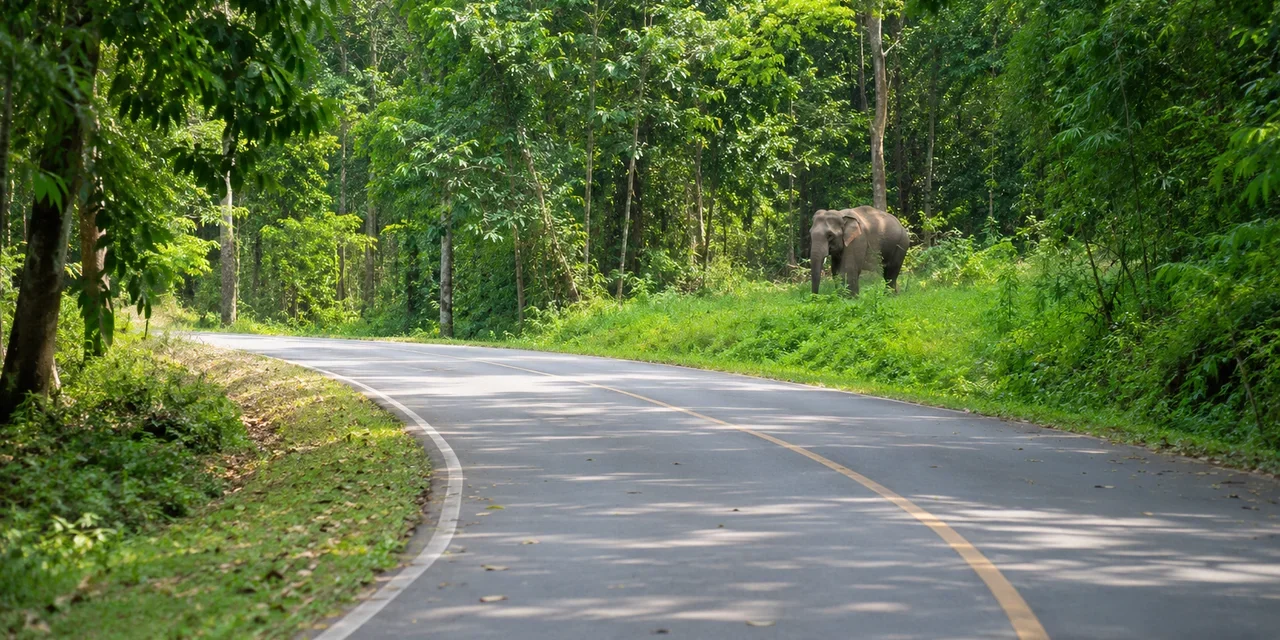
Wild elephant safety in Thailand deserves attention on roads as well as inside parks. An older Personal Thailand post described a fatal elephant encounter near Hua Hin, but I have not independently verified that account. I am not presenting its incident details as established facts.
The original account also speculated about the elephants’ behaviour. I cannot verify those details from the material available, so I will not repeat them as fact or guess why the animals reacted. What follows is practical guidance for visitors who encounter wild elephants.
Wild elephant safety in Thailand: give them space
Elephants can cross roads that pass through their habitat. Khao Yai is one place where drivers may encounter them, and wild elephants also live in the wider Kui Buri area. A forest road is not a viewing platform. If an animal is ahead, slow down and leave plenty of room for it to move away.
Thai government guidance for Khao Yai advises stopping at least 30 metres from an elephant and, if it approaches, carefully reversing. Keep your engine running, look behind you before moving and allow other vehicles to make space. Wait for the animal to leave the road before proceeding.
Thirty metres is a minimum in that guidance, not a promise that you are safe if you stop just beyond it. Terrain, visibility, traffic and the presence of other animals all matter. Follow park rangers and the current instructions for the road you are using.
Do not crowd or follow
Never get out of a vehicle to approach an elephant for a photograph. Do not feed it, block its route, use flash or try to chase it off the road. The government guidance says not to sound the horn or make loud noises that may startle the animal.
Other elephants may be nearby even if you can see only one. Give the whole group room and avoid placing a vehicle between animals. Do not try to judge that an elephant is harmless because it appears calm in a photograph or because someone in another car drove closer.
If vehicles ahead start to reverse, drivers behind need space too. Check mirrors and move carefully rather than trapping the car in front. On a narrow road, patience can be the most useful thing you have in the vehicle.
After dark and on a motorbike
Reduce speed where signs warn of wildlife, especially when vegetation limits visibility. Thai government advice says to keep headlights on when encountering an elephant at night and to avoid flashing lights. The aim is to see the road while avoiding actions that attract or startle the animal.
A motorbike gives its rider much less protection than a closed vehicle. Do not attempt to squeeze past an elephant to save a few minutes. If you can turn back safely before getting close, create distance and contact local park staff. Follow their directions rather than trying to force a route through.
A passenger can help watch for traffic but should not encourage the driver to stop beside an animal for a better view. If you cannot safely reverse or the road is blocked in both directions, remain calm, avoid sudden noise and follow a ranger’s instructions when available. No online checklist can anticipate every encounter.
Visiting Khao Yai or Kui Buri
Before entering a park, check its current opening arrangements, road conditions and ranger guidance. Ask where wildlife viewing is permitted and use designated guides or vehicles where required. Park policies and viewing arrangements can change with weather, animal movement and conservation work.
If you see an elephant outside a park, keep your distance and contact local authorities or the nearest park office for advice. Save the relevant park’s current contact details before setting out rather than relying on an old number found in a travel forum. In an immediate medical emergency call 1669; for police assistance call 191.
People and elephants share the landscape
For a visitor, seeing a wild elephant can be an extraordinary moment. For people who live or work near forest edges, encounters can also be frightening and may affect daily travel or farming. Both perspectives matter. Treat local warnings seriously and leave wildlife management to trained staff.
Elephant safety advice does not require speculation about an animal’s motives. Keep your distance regardless of why an elephant is on the road, and leave wildlife management to trained staff.
For the road trip around your visit, see our guides to road safety in Thailand and motorbike safety. If you are riding in an unfamiliar area, ask local staff about wildlife activity and road conditions before leaving.
Keep a safe distance from any wildlife even when an animal is beside a busy road rather than inside a national park. Sightings are unpredictable, and the presence of other visitors does not mean an animal is accustomed to close contact. Alert the park office when safe, give its staff the location and follow their instructions.
FAQ
How far should I stay from an elephant on a road?
Government guidance for Khao Yai advises at least 30 metres. Give more room when possible and follow rangers’ instructions.
Should I use the horn to move an elephant?
No. Thai government guidance says not to honk or make loud noises to chase an elephant away.
Can I leave my car for a photograph?
No. Stay in the vehicle, leave space and never approach a wild elephant for a closer picture.
Should I use flash when photographing wild elephants?
No. Thai government guidance says to avoid flash because it can startle elephants. Stay inside your vehicle and keep your distance.
More from Personal Thailand
If you enjoy practical reporting and personal perspectives on Thailand, you can support my work and explore member-only content through either platform:
- Subscribe to Personal Thailand on X — creator membership with access to applicable subscriber-only posts and benefits.
- Join or support Personal Thailand on Buy Me a Coffee — browse available memberships and support options.
These are separate services with different charges and membership benefits. Paid access may be required; subscribing on one does not automatically grant access on the other. The main information in this article is free to read above.