Editorially updated 17 October 2026. This article has been rewritten and fact-checked; verify changeable local details again before travel.
From tiny geckos to impressive water monitors, Thailand has remarkable lizard diversity.
A guide to Thailand’s overlooked reptiles
Look closely at a garden wall, tree trunk or quiet pond in Thailand and you may notice several very different lizards. Some are tiny insect-hunting geckos, while others are striking water monitors. Thailand’s national biodiversity database, run by the Office of Natural Resources and Environmental Policy and Planning (ONEP), records all seven species described here. The aim is to help visitors identify possibilities responsibly, not to encourage capturing animals. Colours, size and markings vary, and a photograph may be needed for reliable identification.
1. Tokay gecko
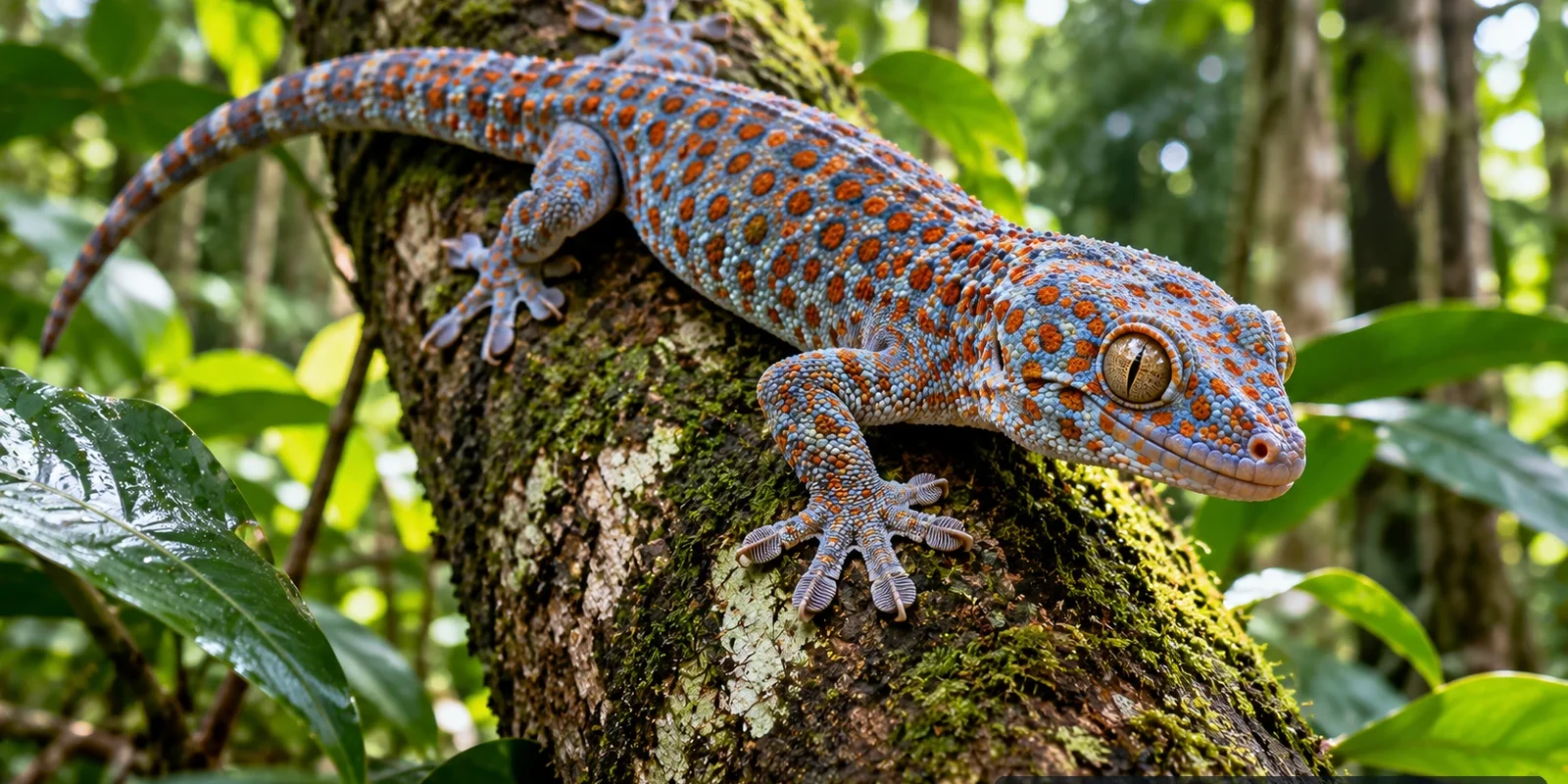
The tokay gecko (Gekko gecko) is one of Thailand’s most distinctive nocturnal reptiles. It has a robust body, conspicuous spots and a call that can sound like its name. The Smithsonian National Zoo describes its strong grip and powerful defensive bite. Tokays may occupy tree trunks, rock crevices or suitable buildings. Observe one from a comfortable distance and do not try to pull it from a wall or carry it for a photograph. Its impressive appearance is best enjoyed without touching it.
2. Common house gecko
The familiar small house gecko is often associated with Hemidactylus frenatus, an insect-eating lizard that can appear near lamps, ceilings and windows. ONEP’s Thai biodiversity database records this species. Its presence is not a reason to panic: geckos generally hunt insects rather than seek interaction with people. Keep food covered, clean up crumbs and let the animal move away naturally. There is no need to chase it around a guesthouse room.
3. Flat-tailed or frilly gecko
The flat-tailed house gecko, often listed as Hemidactylus platyurus and in older records as Cosymbotus platyurus, has body margins that may help it blend with the surface around it. ONEP’s database lists the older name Cosymbotus platyurus as a synonym of Hemidactylus platyurus. Because several small geckos can look similar from a distance, do not make a definitive identification from colour alone. Photograph patterns and tail shape from a distance if you want to check later.
4. Changeable lizard
The changeable or oriental garden lizard (Calotes versicolor) is a daytime species associated with shrubs, gardens and other vegetated spaces. It is listed in ONEP’s Thai biodiversity database. Its colouring and posture can change, which sometimes makes visitors think they have seen several species on the same walk. If you find one basking, give it room. Chasing a lizard into the road or rough vegetation is dangerous for the animal and unnecessary for a good photograph.
5. Flying lizard
Despite the dramatic name, flying lizards do not fly like birds. Species such as Draco maculatus, listed in ONEP’s Thai biodiversity database, glide between trees using specialised membranes supported by elongated ribs. They are easiest to appreciate with patience in suitable woodland rather than by disturbing trees to make them move. Stay on designated trails, especially in protected areas. A tiny gliding lizard is an excellent reminder that Thailand’s smaller wildlife deserves just as much attention as its famous mammals.
6. Asian water monitor
The Asian water monitor (Varanus salvator) is a large lizard associated with waterways and wet habitats. Thailand’s ONEP biodiversity database documents it under the common name water monitor. Its size can surprise first-time visitors, including in some urban green spaces, but a monitor simply crossing a path is not an invitation to approach. Keep children and pets away, allow an escape route and never try to feed or capture one. Contact local park staff if an animal creates an immediate safety problem.
7. Many-lined sun skink
The many-lined sun skink (Eutropis multifasciata, also found in older sources under Mabuya multifasciata) is a smooth-bodied, quick-moving lizard that may appear in sunny gardens and among leaves. ONEP’s Thai biodiversity database records it. Skinks are often mistaken for small snakes because their legs can be less obvious when they dash through vegetation. Observe quietly and resist the urge to handle it. The point of identification is appreciation, not possession.
What to do if a lizard enters your accommodation
Most encounters do not require intervention. Give a small gecko a route outside if that is practical, do not spray pesticides indiscriminately and never grab a large monitor. If an animal is trapped or injured, ask hotel staff or the relevant local wildlife service for appropriate assistance. Do not assume all lizards are harmless to handle: a bite can cause injury or infection even when the species is not venomous. Keep hands away and seek medical advice for significant wounds.
Frequently asked questions
Are geckos useful? Many feed on insects, although that is not a reason to handle them.
Are water monitors the same as crocodiles? No; they are lizards.
Can every lizard be identified from a quick photo? Not reliably. Several species look similar and specialists may be needed.
Sources and further reading
- ONEP Thai Biodiversity Information Facility — tokay gecko (Gekko gecko)
- ONEP Thai Biodiversity Information Facility — common house gecko (Hemidactylus frenatus)
- ONEP Thai Biodiversity Information Facility — flat-tailed house gecko (Hemidactylus platyurus)
- ONEP Thai Biodiversity Information Facility — changeable lizard (Calotes versicolor)
- ONEP Thai Biodiversity Information Facility — spotted flying lizard (Draco maculatus)
- ONEP Thai Biodiversity Information Facility — many-lined sun skink (Eutropis multifasciata)
- Smithsonian National Zoo — tokay gecko
- ONEP — Asian water monitor
Editorial disclosure: Featured image is AI-generated and marked © PersonalThailand.com | AI-generated image. Sources were accessed during editorial research, but page availability and current advice must be checked at publication.