
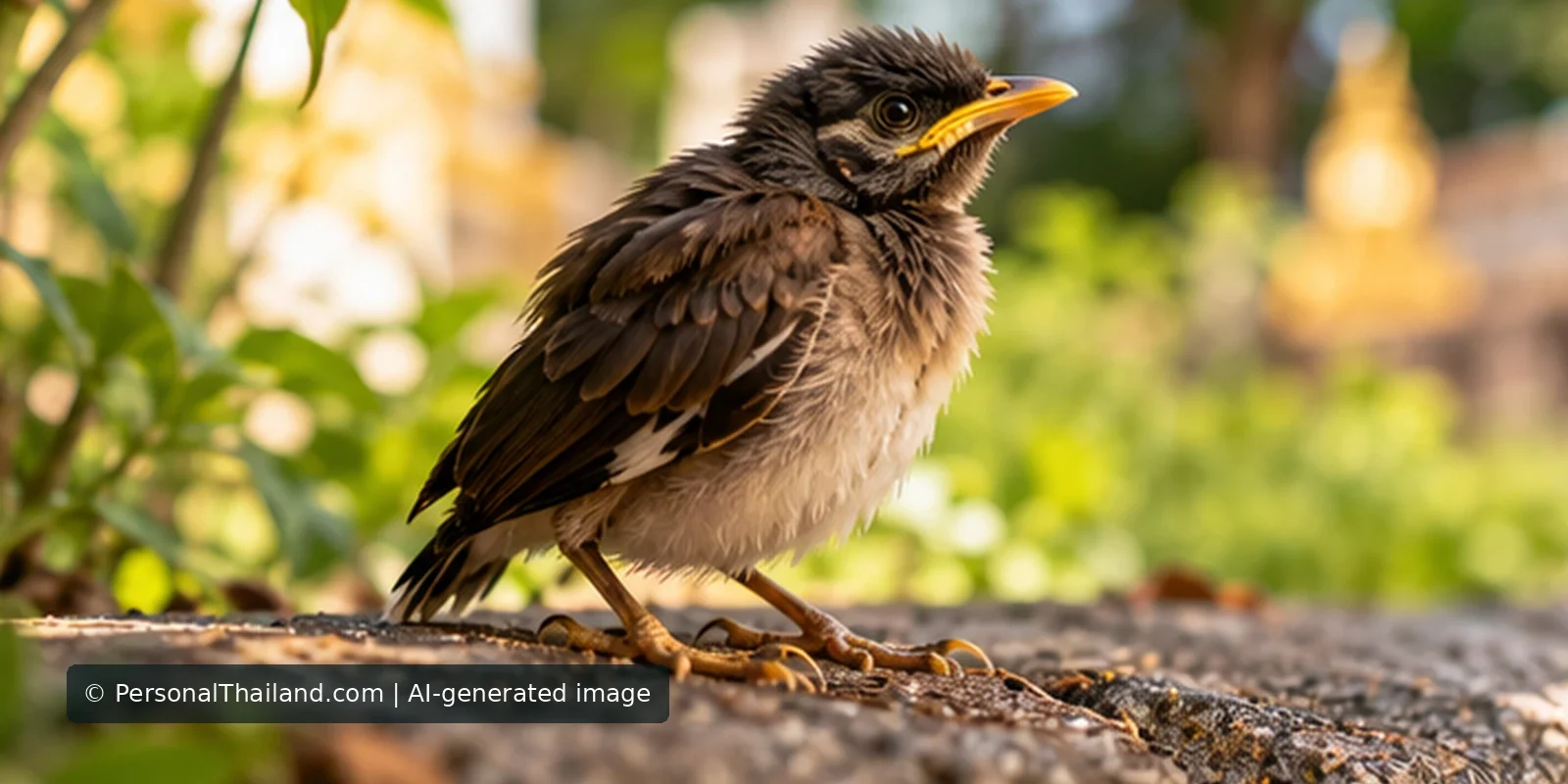
A tiny bird on the ground can make anyone want to help, especially when the sun is strong or cats are nearby. But the best first move is often to watch from a distance rather than pick it up. A fully feathered young bird may be learning to fly while its parents continue to feed it; moving it away could do more harm than leaving it where the adults can find it.
This article began as a personal account of trying to save a fallen baby bird in Thailand. The experience was sad, but it offers a useful lesson: young wild birds need species-specific care, and well-intentioned home treatment is not automatically safe.
First identify what kind of young bird you have found
Fledgling: A young bird with most of its feathers may hop or flutter along the ground and still be unable to fly well. For many common garden birds, this is a normal stage of development. The parents are often nearby even if you cannot see them. Unless it is injured or in immediate danger, leave it in the area and keep pets and people back.
Nestling: A very young bird with few or no feathers generally belongs in a nest. If you can safely identify and reach the exact nest and the bird is not injured, seek appropriate rescue guidance on returning it. If access is dangerous or you are unsure of the species, contact a qualified wildlife rehabilitator or veterinarian first.
These are useful general distinctions, not universal rules for every Thai species. The RSPB’s guidance on young birds specifically notes exceptions, including some species whose fully feathered young should not be on the ground.
What to do in the first few minutes
- Look for hazards. Keep cats, dogs, traffic and crowds away. Do not stand over the bird longer than necessary.
- Check without touching. Observe whether the bird can stand, has obvious injuries or appears trapped in string, netting or a drain.
- Give the parents room. Move back. Adult birds may avoid returning while a person is watching at close range.
- Move only if necessary. If a healthy fledgling is in the path of a vehicle or other immediate danger, move it a short distance into nearby shelter where its parents can still locate it.
- Ask for local expertise. A wildlife rescue, bird-experienced veterinarian or the relevant Thai wildlife authority is a better source for species-specific decisions than a social-media comment.
When professional help is urgent
An injured bird, one that has been caught by a cat or dog, or a bird that cannot stand or breathe normally needs prompt professional assessment. The RSPCA’s baby-bird advice recommends contacting a wildlife rescue or veterinarian when a bird is visibly hurt. The RSPCA is a UK charity, so any rescue contacts it lists apply in the United Kingdom; they are not numbers to call in Thailand.
If rescue staff ask you to transport the bird, follow their handling instructions. Minimise handling, keep it away from children and pets, and do not allow people to gather around for photos. Avoid touching the face after handling any wildlife and wash your hands thoroughly.
Why you should not guess what to feed it
Baby birds have different diets according to their species and stage of growth. Bread, milk, rice or a random mix of seeds may be unsuitable. Attempting to force water into a chick can also be dangerous. Even a bird that looks hungry may be more urgently in need of warmth, a safe nest or veterinary treatment than food.
Do not follow an improvised online feeding schedule or use a heat lamp simply because a chick is small. Overheating and incorrect food can cause additional problems. Until a qualified rescuer tells you otherwise, your priority is keeping the bird safe and obtaining professional advice, not hand-rearing it yourself.
Special issues in Thailand
Thailand has many wild bird species, and identification matters. A young bird found near a house might not have the same needs as a bird found in a wetland, forest or coastal area. Protected-species rules and rescue procedures may also apply; do not assume you can keep a wild bird as a pet because you found it on your property.
Because local rescue organisations and contacts vary by province, ask a nearby licensed veterinary clinic or wildlife-rescue network for the appropriate current contact rather than depending on an old telephone number from a blog. When describing the bird, share the location, whether it has feathers, whether it is injured and whether the parents have been observed.
Make your home safer for birds
Preventing the next accident may be more helpful than trying to rescue a bird after it is hurt. Keep cats away from nesting areas, use care when trimming trees during nesting activity, and look for active nests before repairing eaves or roofs. Where large windows cause collisions, consider visible window markers. Never pull apart an active nest merely to examine the chicks.
A healthy fledgling cared for by its parents has a much better chance than one kept unnecessarily in a house. Kindness sometimes means staying back, watching carefully and letting wild birds continue their own lives.




1 Comment