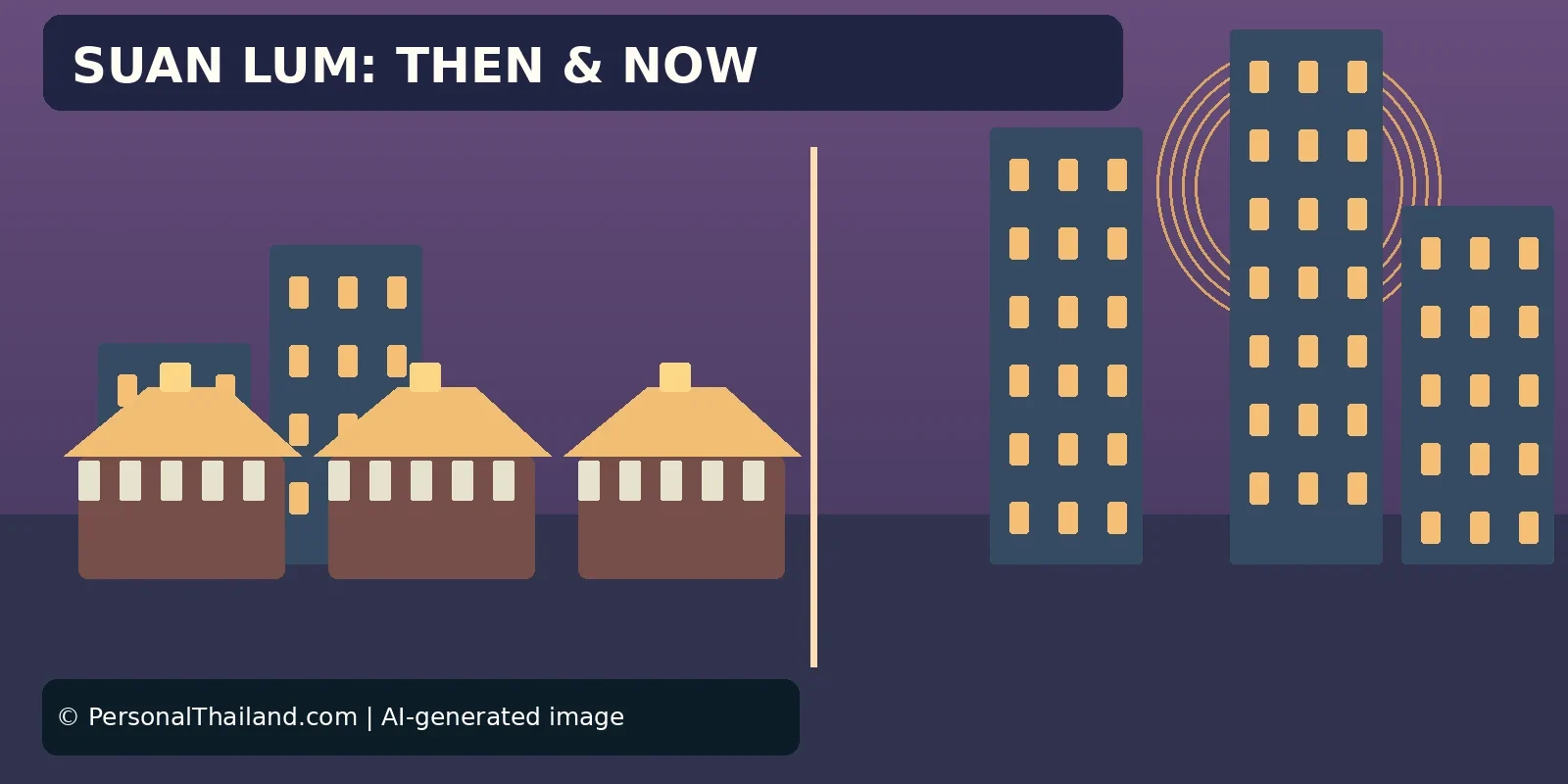
A night market that lives on in memory
Travellers who visited Bangkok years ago may remember Suan Lum Night Bazaar for outdoor stalls, browsing after sunset and meals beneath an open sky. The atmosphere gave visitors a different experience from air-conditioned department stores: you could wander, compare handmade items and stop for food without planning every minute. The original Personal Thailand article, written in 2007, worried that a favourite public gathering place would give way to another major commercial development.
That older article is useful as a personal reaction from its time. It is not a current listing for a market you can still visit. The old Suan Lum Night Bazaar closed, and the land has been redeveloped. A tourist planning a Bangkok trip now needs both that historical context and a clear explanation of what is there today.
Where the original bazaar stood
The old bazaar occupied a prominent part of the Rama IV and Wireless Road area, near Lumphini Park. Its central location made it memorable for travellers who combined park walks, evening food and shopping. It was a particular place, not a generic name for every night market in Bangkok.
The relationship between the site and its successor is well documented. Reporting on the redevelopment identifies the old bazaar land as part of the new project, while One Bangkok’s own art programme recalls the now-defunct Suan Lum Night Bazaar as an important setting for Bangkok artists. See the One Bangkok public-art account of Alex Face for that connection.
What is on the site now?
One Bangkok officially opened to the public on 25 October 2024, describing itself as a large mixed-use urban district with shopping, offices, hospitality, public spaces and art. It is not a restored version of the old night bazaar, and its tenant mix and retail phases may change over time. Visitors should expect a very different setting from the informal outdoor market that many remember.
A useful way to approach the site is to look at both the modern development and its location near Lumphini Park. You can appreciate the new buildings while also remembering the smaller merchants and nightlife atmosphere that once helped define the neighbourhood. Urban change is often more complicated than a simple story of progress or loss.
Why the old market mattered
Night bazaars bring together more than products. They create a place for casual evening walks, inexpensive browsing, food stops and exchanges between residents, small businesses and visitors. Those experiences are hard to reproduce exactly inside a new district built for many kinds of commercial activity.
At the same time, nostalgia should not turn into a claim that every stall was cheap, every product authentic or every former trader had the same outcome. We do not have a verified roster of all the old tenants or a documented relocation path for every business. It is more accurate to speak about the bazaar’s atmosphere and disappearance than to invent stories about where individual vendors went.
Can you still visit Suan Lum Night Bazaar?
Not as the old outdoor bazaar shown in photographs from the 2000s. Searching the name online may still bring up old reviews, photographs or addresses, and some travel articles have never been corrected. Check the publication date before building an itinerary around them. A website or tour listing mentioning Suan Lum without a current venue address deserves further scrutiny.
If you want to see what replaced the former site, consult One Bangkok’s official visitor information. If you want a market-style evening, choose a currently operating market elsewhere in Bangkok after verifying its address, opening days and trading hours. Neither experience is a direct substitute for the original bazaar.
An easy historical walk around the district
A traveller interested in the area can combine a daytime or early-evening visit to Lumphini Park with a look at the newer streetscape around Rama IV Road and Wireless Road. Take ordinary care when crossing large junctions and follow marked pedestrian routes. The park, the transport network and newer public spaces make it possible to appreciate several eras of the city within a compact area.
For a deeper understanding, read the development’s publicly documented art and heritage descriptions rather than assuming its present-day architecture preserves the historic stalls. Not every piece of public art is directly about the bazaar, but neighbourhood history can be part of the conversation.
Remember the market, plan for the city that exists
The question raised in 2007—what happens when an outdoor market disappears during redevelopment—remains worth discussing. Bangkok has never been a static city, and redevelopment can change the everyday experiences of both locals and repeat visitors.
A good travel guide should let the past remain the past. Suan Lum Night Bazaar is part of Bangkok’s commercial memory; One Bangkok is a present-day destination on its former site. Knowing the difference prevents wasted journeys and makes an ordinary walk through this part of Bangkok more interesting.