
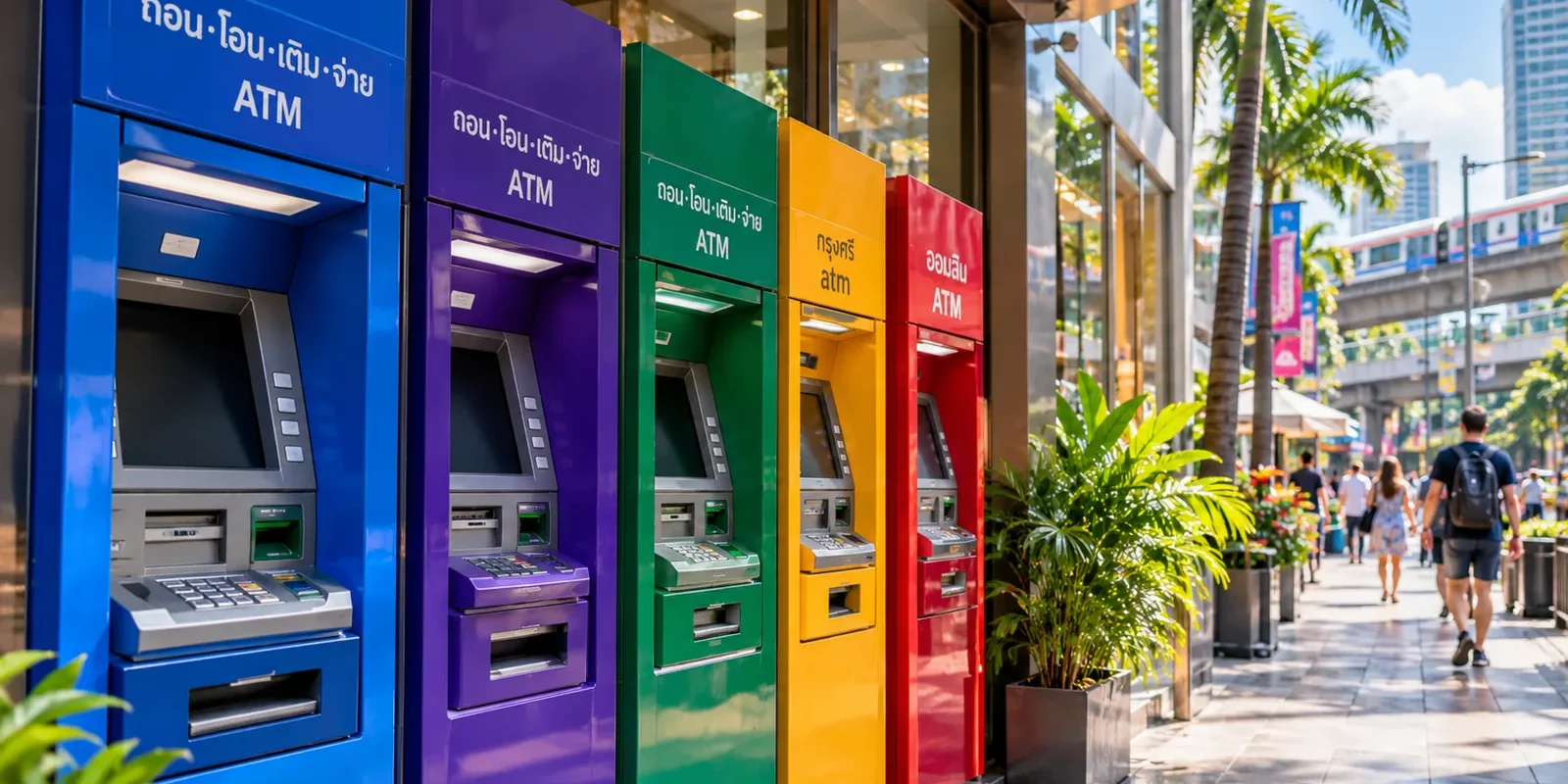
Updated 16 October 2026. ATM charges can change without notice. The figures below come from one named bank’s published 2026 tariff and must not be mistaken for guaranteed fees at every Thai ATM.
In 2009, this article reported a 150-baht charge for foreign Visa withdrawals in Thailand. That number should not be used to plan a trip in 2026. Travelers may now pay a local ATM operator fee, an additional fee from their home bank and, if they accept it, an unfavorable currency conversion. These are three separate costs.
What do foreign cards cost at Thai ATMs in 2026?
For a useful concrete example, Krungsri (Bank of Ayudhya) published a tariff effective 11 March 2026 for withdrawals at Krungsri ATMs using cards issued outside Thailand:
| Foreign-issued card network | Krungsri ATM operator fee, March 2026 schedule |
|---|---|
| Visa | 250 THB per withdrawal |
| Mastercard | 350 THB per withdrawal |
| UnionPay / JCB | 250 THB per withdrawal |
These are Krungsri’s published operator charges, not a claim about every Thai bank, every card product or your card issuer’s policies. The screen should show the relevant local withdrawal fee before you confirm the transaction. Cancel if you do not accept it.
Why can the final cost be higher?
1. Thai ATM operator fee
This is the charge imposed for using the cash machine with an overseas-issued card. It is often a fixed amount per transaction, making multiple small withdrawals relatively expensive. Charges may depend on the ATM operator and card network.
2. Your card issuer’s charge
Your bank or card provider may add an international ATM, cash-advance or foreign transaction fee. Some travel-focused accounts reimburse ATM operator fees, but eligibility varies. Check your issuer’s written terms, and distinguish debit-card withdrawals from credit-card cash advances, which may attract interest.
3. Dynamic currency conversion (DCC)
An ATM may ask whether you want the transaction converted to your home currency on the screen. That service is called dynamic currency conversion. Visa explains that the offered exchange rate can contain an additional markup and that customers must have the choice to accept or decline it. Selecting Thai baht (THB) and declining the ATM’s conversion offer often allows your own card network and issuer to handle conversion instead. Review your issuer’s terms: declining DCC does not make withdrawals fee-free.
How to reduce unnecessary charges
- Use an ATM at a bank branch or reputable, well-lit location. Check the card slot and keypad for unusual attachments and shield your PIN.
- Read the fee notice before pressing confirm. Different machines, cards and fee schedules can produce different amounts.
- Withdraw a planned amount rather than repeated tiny sums. A fixed operator fee is a bigger percentage of a small withdrawal, though carrying too much cash also creates risk.
- Decline home-currency conversion unless you have compared the rate. DCC is optional; read the on-screen exchange-rate information.
- Check your card’s daily limit and your own bank’s fees. ATM limits are not the same as your bank account’s limit.
- Keep transaction records. If cash is not dispensed but the account is debited, document the machine, time and amount, then contact your issuer.
A simple fee example
Suppose you withdraw 10,000 THB using a foreign-issued Visa card at a Krungsri ATM, and the applicable local operator fee is 250 THB. The local operator fee alone would equal 2.5% of the cash amount. With a 20,000 THB withdrawal, the same 250 THB fee would be 1.25%, assuming that machine and your bank allow that amount. Your issuer’s fees and exchange-rate conversion are additional, so the final total can be higher.
Using a credit card to withdraw cash may trigger separate borrowing charges. A purchase paid by card and a cash withdrawal are not equivalent transactions.
Frequently asked questions
Are all Thai ATMs exactly the same price?
Do not assume so. Our cited example is Krungsri’s March 2026 tariff. Check the current machine’s fee disclosure and the issuing bank’s own schedule.
Is 150 THB still the correct fee?
Not for the foreign Visa/Mastercard transactions listed in the cited Krungsri schedule. The original 2009 claim is obsolete.
Can I avoid all foreign ATM fees?
Sometimes an account reimburses fees, or a different withdrawal or payment method works out cheaper. There is no universal free-ATM promise; compare your actual total cost and safeguard your cash.
Sources
- Krungsri official ATM fees, effective 11 March 2026 (PDF, page 8)
- Visa: Understanding dynamic currency conversion
Bottom line: Check the actual ATM fee, your home bank’s fee and the currency-conversion choice before confirming a withdrawal. Saving money starts with seeing all three.



yes i seen that info but as you know Thai visa sometimes have 20 pages of no info. I try to keep it short and to the point.
I used a foreigners visa debit card.
That good info i will check that when i have to take out money. I thought UOB already did it. When i took out last time all the other banks except Bangkok Bank did not let me take out more then 10 000 THB. I will not take out 10 000 THB at the time and pay 150 THB for it.
Aeon and GSB (Government Savings Bank) ATMs do not charge the fee. UOB is a Malay bank and was not charging as of Thursday.
What about regular ATM debit cards? Do banks charge a fee for this? What is more common in Thailand the Plus or Cirrus option?
Wealth of information here, to the point of overload.
I use a USA Visa ATM. I should note that GSB only works on VISA ATMs.