Last checked: 31 October 2026. Thai rules change often, so always confirm with the official source before you travel or apply.
Jet ski scams in Thailand were the subject of this page’s older complaints about damage claims in Phuket and Pattaya. The original article made broad allegations about operators, insurance and officials that it did not substantiate. I would rather give readers a useful way to assess a rental, document its condition and get help if a dispute develops.
Jet ski scams in Thailand: understand the concern
The disputed-damage scenario is straightforward: after a rental, a customer is asked to pay for damage they say was already present or did not occur during their use. That does not make every damage claim fraudulent. It means the condition record, contract and explanation of the charge matter. A fair assessment needs more than two people pointing at a scratch.
Australian travel advice reviewed in 2026 warns against leaving a passport with a jet ski or motorcycle rental business as security, noting that it may be retained during a damage demand. I would treat a demand to surrender the original passport as a reason to choose another activity. A short ride should not put control of an essential travel document in someone else’s hands.
This update does not claim that all operators are uninsured, unregistered or dishonest. It also does not promise that an insurance scheme has removed every possible dispute. The useful question is what applies to this rental, with this operator, under the terms you are being asked to accept today.
Before money changes hands
Ask for the total price, rental duration, permitted area and return arrangements. Read the agreement in a language you understand. If the terms are only explained verbally, ask for the important points in writing. A queue behind you is not a reason to sign a document you have not understood.
Establish who the business is and how it can be contacted afterwards. Keep the receipt and any booking messages. Ask what happens if weather conditions change or equipment develops a problem. If the answers are vague, the safest decision may be to decline the rental before you are committed.
I would not let a low headline price determine the choice. The relevant cost includes any deposit, possible excess, exclusions and the practical risk of a dispute. There is no bargain in an arrangement you cannot explain clearly to the person travelling with you.
Record the condition together
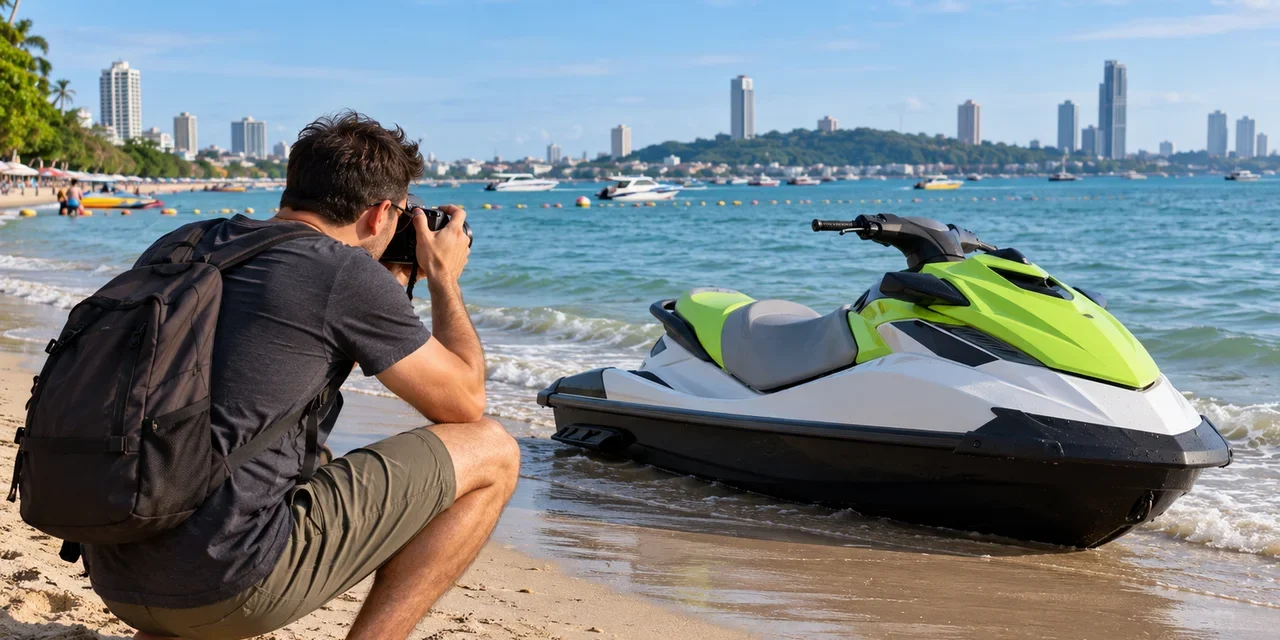
Before starting, inspect the craft with the operator present. Look at both sides, the front and rear, seating and visible fittings. Take clear photographs and a slow video showing the overall condition as well as existing marks. Keep the original files. Do not rely on one distant photograph taken while somebody is already pushing the craft into the water.
Ask the operator to acknowledge existing damage on the rental record. Photographs can help, but they do not automatically settle questions about hidden damage or the cause of a fault. If an area cannot be checked safely, do not crawl underneath or interfere with the equipment; ask how its condition is recorded.
Agree how the return inspection will work before departing. A useful process compares the same craft, in a suitable position, against the original record. If the operator changes the equipment after you have photographed it, start the check again rather than assuming similar appearance means identical condition.
Ask what insurance actually covers
The word insured is the beginning of a conversation, not the answer to every question. Ask which risks are covered, who is insured and what the customer may have to pay. A policy covering the craft may not provide the protection you expect for injury, liability or every type of damage.
Check your own travel policy separately. Describe the activity accurately and ask about exclusions or conditions before renting. Keep the written response. Do not assume that a general water-sports phrase covers the exact activity, operator or circumstances involved.
I am deliberately not quoting an insurance excess or repair tariff here. This review has not verified a universal amount for rentals in Phuket or Pattaya in 2026. If someone produces a fixed charge, ask where it appears in the agreement and what evidence supports applying it to your situation.
Safety comes before the paperwork
A careful contract cannot compensate for unsafe equipment or conditions. Ask for a suitable life jacket and a clear explanation of the controls, stopping procedure and operating area. If you do not understand the instructions, do not start. Declining is a sensible decision, not an embarrassment.
Keep clear of swimmers, boats and restricted areas, and follow the applicable local instructions. Avoid riding after drinking. If the weather or visibility is unsuitable, choose another day or another activity. Travel advice checked in 2026 cautions that tourism operators’ safety and maintenance standards can vary, so do not treat a busy beach as an inspection certificate.
For an island day, our Koh Larn safety guide covers transport and beach planning. I would make those arrangements first rather than adding an activity that leaves no time for the return journey.
If a damage dispute starts
Stay calm and keep the discussion in a public place. Ask to see the alleged damage, the contractual basis of the charge and an itemised explanation. Show your original condition record. Avoid signing an admission or agreement that you do not understand, and do not turn the disagreement into a physical confrontation.
As checked in 2026, Tourist Police assistance is available on 1155. If there is an immediate threat, use the police emergency number 191. Explain the location, the dispute and any immediate safety concern. If you feel unsafe, prioritise getting help rather than trying to win an argument on the beach.
Keep messages, receipts and the names of witnesses who agree to be contacted. If a payment is made, ask for a receipt stating its purpose and retain a copy. Where a substantial claim remains unresolved, obtain independent legal advice. Police assistance, an insurer’s involvement or a complaint does not guarantee a particular financial outcome.
There are other ways to spend the day
A beach visit does not need a motorised activity to feel complete. You might choose a walk, a meal or a supervised activity whose terms and safety arrangements you can verify. The alternative should still be assessed on its own merits; changing the equipment does not remove the need to ask questions.
For getting around Phuket afterwards, our guide to fares and transport choices applies a similar principle: establish the arrangement before starting. Clear expectations help honest businesses and customers alike.
The lesson I want to preserve from the old post is the value of taking a disputed charge seriously. The part I want to leave behind is the assumption that every person in an industry is guilty. Good records, clear terms and a willingness to walk away are more useful than an angry generalisation.
FAQ
Do photographs guarantee that I will win a dispute?
No. They can help document visible condition, but they do not establish every cause of damage or replace the agreement and other evidence.
Should I leave my passport as security?
I would not. Australian official advice reviewed in 2026 specifically warns against giving a passport to a rental business as a guarantee.
Does the operator’s insurance cover everything?
Do not assume so. Ask about the policy, insured risks, exclusions and any customer liability, then check your own travel cover separately.
Who can help if I feel threatened over a payment?
Contact Tourist Police on 1155, or police emergencies on 191 if there is an immediate threat. Prioritise safety and keep the relevant records.
More from Personal Thailand
If you enjoy practical reporting and personal perspectives on Thailand, you can support my work and explore member-only content through either platform:
- Subscribe to Personal Thailand on X — creator membership with access to applicable subscriber-only posts and benefits.
- Join or support Personal Thailand on Buy Me a Coffee — browse available memberships and support options.
These are separate services with different charges and membership benefits. Paid access may be required; subscribing on one does not automatically grant access on the other. The main information in this article is free to read above.