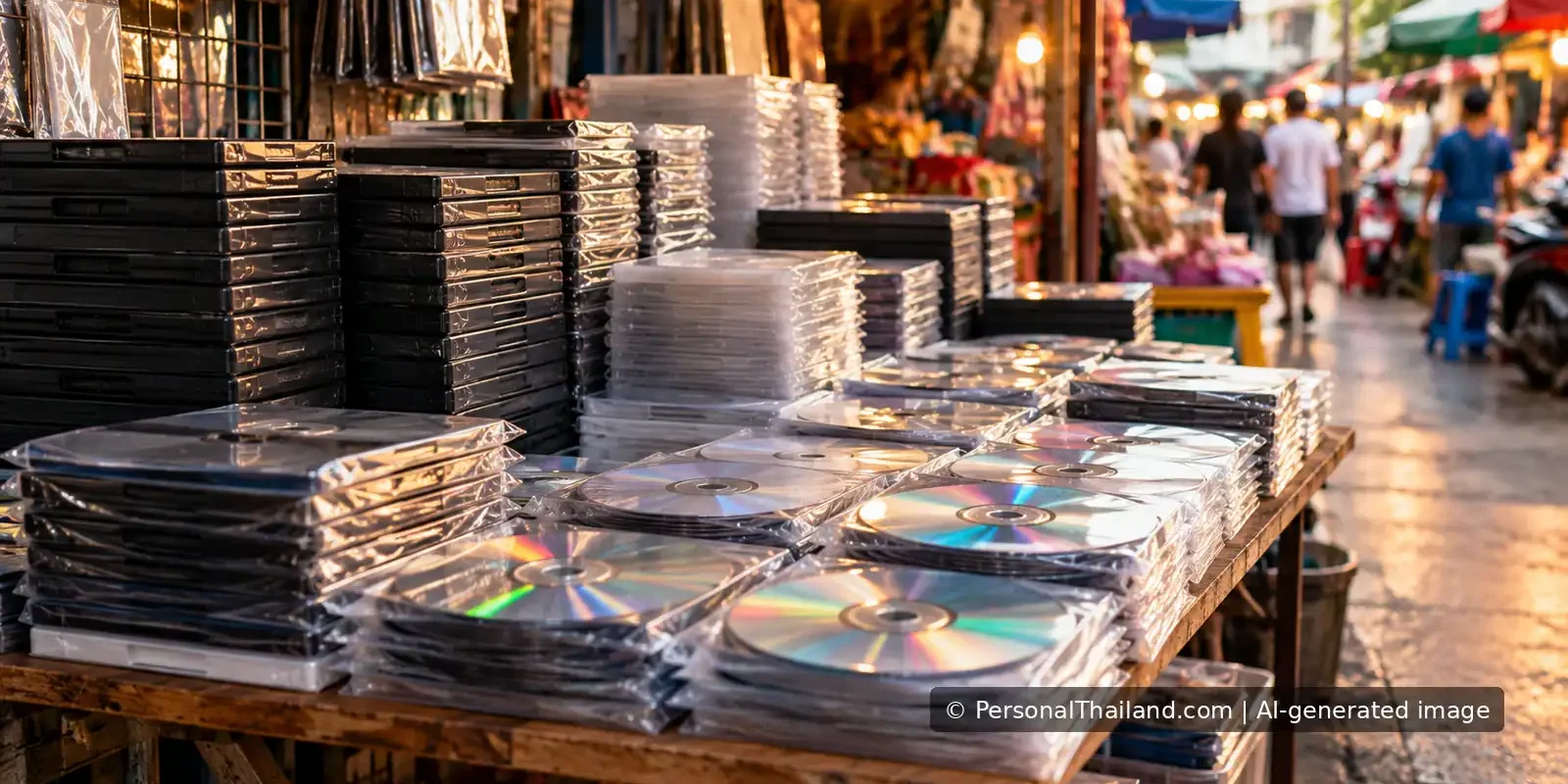
In February 2009, this site described another announced crackdown on pirated DVDs and VCDs in Bangkok. At the time, inexpensive discs were easy to discuss as a street-market problem. Almost two decades later, the larger question is how film creators, distributors and audiences deal with copyrighted entertainment in a world dominated by downloads, video platforms and subscriptions.
The 2009 article included opinions and accusations about police officers, retailers and market operators that were not independently established. Those allegations should not be mistaken for a proven description of specific people or today’s shopping centres. The real issue worth examining is what makes an unauthorised copy different from a legitimate purchase or viewing licence.
Why DVDs were such a visible part of the story
Physical DVDs and VCDs were a familiar way to buy movies in Bangkok in the 2000s. A shopper could inspect a disc and its packaging, but it was not always clear whether the seller had permission to reproduce and distribute the work. The price alone did not prove legality, and attractive packaging could still conceal an unauthorised reproduction.
Enforcement stories about particular markets also reflected changing priorities. An announcement of inspections did not demonstrate that an entire venue sold unlawful goods, nor that any individual had been convicted. The 2009 discussion of Siam Square, shopping centres and trade negotiations was a snapshot of a particular period, not a current directory of places to avoid.
What does Thai copyright law protect?
Movies, sound recordings, television programmes and other creative works can carry copyright protection. The Thailand Department of Intellectual Property’s legislation collection provides official information about the Copyright Act and amendments. Reproducing or communicating protected works without the necessary permission can infringe rights, although the legal answer depends on the act involved, the rights held and applicable exceptions.
It is more useful to ask who owns or licenses the film and whether the distributor is authorised than to assume every cheap product is fake or every expensive product genuine. Buying a physical disc, streaming a film, recording a performance and uploading a clip are different activities, with different rights potentially involved.
The shift from market stalls to online distribution
Digital delivery changed the economics of copying. Instead of pressing discs and transporting stock, an unauthorised distributor may post a file, operate a misleading streaming site or share links across social media. This does not mean physical piracy disappeared, but it changes where viewers encounter the risk.
In a dated statement from September 2026, Thailand’s Ministry of Commerce described efforts against online distribution of unauthorised films and television content. The broader Department of Intellectual Property’s anti-piracy resources also show that protection is an ongoing regulatory subject, rather than an issue settled by one raid in 2009.
Platforms and rights holders may also remove infringing content or restrict accounts. A video appearing in search results is not necessarily uploaded with permission. Equally, an older movie or independent work is not automatically free to copy just because it can be found on an obscure website.
How can viewers choose legitimate films?
- Check whether the streaming platform or retailer identifies the distributor and provides ordinary purchase or subscription terms.
- Be wary of apps that demand unusual permissions, unknown installation files or payment-card details before showing a movie.
- Look for normal customer support, refund policies and information about access in Thailand.
- Remember that a platform’s catalogue can differ by country; a film available elsewhere may not be licensed locally.
- If buying a used physical disc, assess the seller, packaging and reasonable provenance rather than relying on a claim of authenticity.
Legal availability can change without notice. A subscription may provide access for a period without transferring ownership of the underlying film. That distinction matters if a title is later removed from a catalogue or a customer’s subscription ends.
Why copyright matters beyond enforcement
Film production employs writers, performers, camera crews, technicians, editors, translators and local businesses. Distribution agreements help finance those contributions, although licensing arrangements are often complex. Consumers also benefit from knowing which services are accountable for the content they offer and for the security of their payment systems.
It is possible to discuss aggressive enforcement and fair access without accusing unnamed people of taking bribes. Questions about penalties, exceptions and enforcement outcomes should be answered with a current legal source or case record, not speculation from an old blog post.
What changed since the 2009 article?
The enduring lesson is not that another Bangkok market raid will solve every infringement problem. It is that copyright travels with the creative work as the medium changes. In 2009 the focus was copied discs; in 2026 it also includes online files, apps and unauthorised streaming. Checking a legitimate source protects both the viewer and the people who made the film.