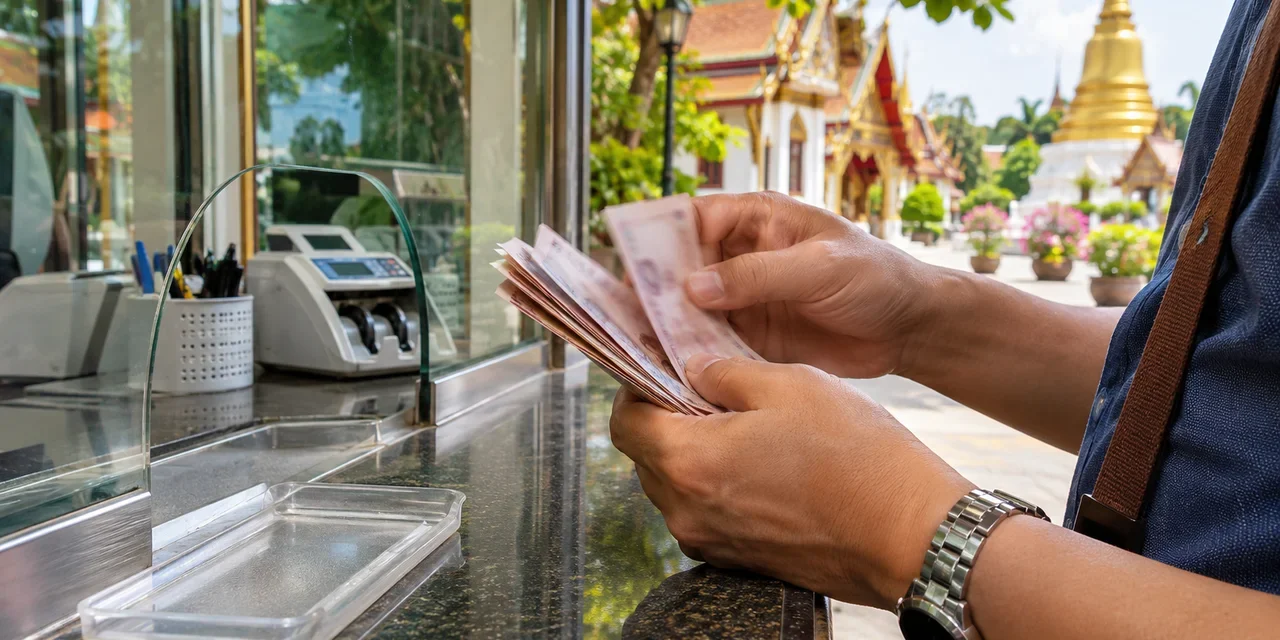
Counterfeit money in Thailand is a problem no traveller wants to discover at a shop counter. If a note looks suspicious, do not knowingly pass it on. Ask a bank or the police what to do and keep a record of where you received it.
An earlier post on this page reported the arrest of a Swedish man in Hua Hin over suspected counterfeit dollars. I have not independently verified the outcome, and an arrest is not a conviction. The old article also suggested a fake note could simply be exchanged at a bank; that is not something to assume.
Counterfeit money in Thailand: what the central bank says
The Bank of Thailand advises people to examine notes they receive, especially higher denominations, and not to use or pass on counterfeit notes. Its guidance says to notify the police or the central bank when counterfeit money is received. If you are uncertain whether a note is genuine, ask a bank or police for help rather than attempting to settle the question by spending it.
Keep the transaction receipt and note when and where you obtained the money. If it is safe, record the name and location of the exchange business and any other details you already have. Do not accuse an individual publicly on the basis of a doubtful note; mistakes and misunderstandings need to be examined.
Ask the bank or police how to submit the note and what record you will receive. Do not expect a suspected or confirmed counterfeit to be replaced at face value. A genuine damaged note is a different matter with a separate examination process; it should not be confused with a counterfeit.
Where to exchange money
Use an established bank or a properly authorised exchange business. Look at the displayed buying and selling rates, ask about fees and confirm how much Thai currency you will receive before handing over cash. A rate that looks attractive from the pavement may not be the final amount after a commission.
Count the money at the counter and compare it with the receipt. If anything appears wrong, ask staff to explain it before leaving. Keep the exchange slip with your travel documents or photograph it and store the image securely. You may need it later to reconstruct a transaction.
Do not accept help from a stranger who offers to exchange money privately because the rate is supposedly better. Apart from counterfeit risks, it can be difficult to verify the amount or obtain a record if a dispute arises. Use the business’s own counter and avoid counting a large sum in the street.
Learn the basic checks
The Bank of Thailand describes a “feel, look and tilt” approach to the security features of Thai banknotes. Take time to read its current guidance for the note series you are handling. Genuine notes have features designed to be checked in different ways; relying only on the colour or a single detail is less useful.
If you have just arrived, ask bank staff to show you what a genuine note looks and feels like. Check the denomination before putting notes away, especially when you are tired after a flight. Good lighting and a quiet moment are more helpful than trying to inspect cash in a crowded queue.
Foreign currency has its own security features, which vary by issuing country and series. Consult the relevant issuing central bank for that currency. An unfamiliar design is not automatically fake: countries can have multiple legitimate series in circulation.
Cash, cards and backup plans
Carry enough cash for small expenses without keeping all your money in one pocket. A payment card and a separate backup can be useful, but check overseas charges, withdrawal limits and the procedure for reporting a lost card before departure. Keep a safe way to contact the card provider that does not depend on finding the card itself.
At an ATM, choose a location where you feel comfortable and shield your PIN. If the machine does not return your card or cash, contact the bank using its verified number. Keep the time, location and any receipt. Do not accept unsolicited assistance with your PIN or account.
For airport screening, our article on protecting valuables at airport security has related advice. If you are taking public transport, see the guide to Pattaya bus station safety.
When to ask for help
If you suspect you have received a counterfeit, stop using it and speak with your bank or local police. Explain the facts as accurately as you can: where and when you received the note, whether you have a receipt and what makes you uncertain. Ask for an interpreter if you need one.
Tourist Police can be contacted on 1155 for assistance, while police emergency services use 191. For questions about Thai banknotes, consult the Bank of Thailand’s official website or a commercial bank. If an incident involves a foreign national and serious legal concerns, a qualified local lawyer and the person’s embassy may be able to explain available support.
Avoid sharing photographs of another person’s identification or accusing a business online while the facts are unknown. Save your evidence for the people dealing with the matter. A measured response protects you better than trying to make a suspicious note disappear.
FAQ
Should I spend a note I suspect is counterfeit?
No. The Bank of Thailand says knowingly using a counterfeit note is illegal. Ask a bank or police for guidance.
Will a bank automatically replace a counterfeit at face value?
Do not assume that it will. Ask the bank or police about the correct reporting process.
How can I check a Thai banknote?
Use the Bank of Thailand’s current “feel, look and tilt” security-feature guidance for the relevant note.
What information should I keep?
Retain the receipt and a record of where and when you received the note, and provide accurate details to the responsible authority.
More from Personal Thailand
If you enjoy practical reporting and personal perspectives on Thailand, you can support my work and explore member-only content through either platform:
- Subscribe to Personal Thailand on X — creator membership with access to applicable subscriber-only posts and benefits.
- Join or support Personal Thailand on Buy Me a Coffee — browse available memberships and support options.
These are separate services with different charges and membership benefits. Paid access may be required; subscribing on one does not automatically grant access on the other. The main information in this article is free to read above.