Thailand played a foundational role in international astronomy education when Chiang Mai hosted the first International Olympiad on Astronomy and Astrophysics (IOAA) from 30 November to 9 December 2007. A short notice on this website announced the event before it happened. Nearly two decades later, the more interesting story is not an old event timetable but how a Thai-hosted competition became an established international academic Olympiad.
What happened in Chiang Mai in 2007?
The inaugural IOAA brought student teams from around the world to Chiang Mai, Thailand. The IOAA’s official historical record identifies 30 November to 9 December 2007 as the dates of the first competition and records the participating countries. The event was held at Chiang Mai University, according to Thailand’s Promotion of Academic Olympiad and Development of Science Education Foundation (POSN).
The inaugural gathering commemorated the 80th birth anniversary of King Bhumibol Adulyadej and the 84th birth anniversary of Princess Galyani Vadhana. That historical context belongs to the 2007 edition, rather than to the dates or purpose of every subsequent competition.
At the first event, the international board of participating team leaders formally adopted statutes for the Olympiad and elected its first leadership. That matters because an academic competition needs agreed standards, not simply a venue and a collection of examination papers.
Why Thailand helped establish a new astronomy Olympiad
Thailand already had a developing astronomy education network before 2007. POSN explains that activities involving Chiang Mai University, regional astronomy centres and the Thai Astronomical Society helped students prepare for international astronomy competitions. Those training programmes connected school learning with more demanding astronomical calculations and observation.
POSN’s account also explains why the IOAA emerged as a distinct competition. Plans involving an existing international astronomy competition led to a new initiative combining astronomy with astrophysics, supported by educators from Thailand and other countries. A trial competition was held in 2006 before the inaugural IOAA in 2007.
The value of this story extends beyond one school contest. It illustrates how domestic teacher networks, universities and international cooperation can develop into a lasting route for academically motivated students.
What do astronomy Olympiad students actually study?
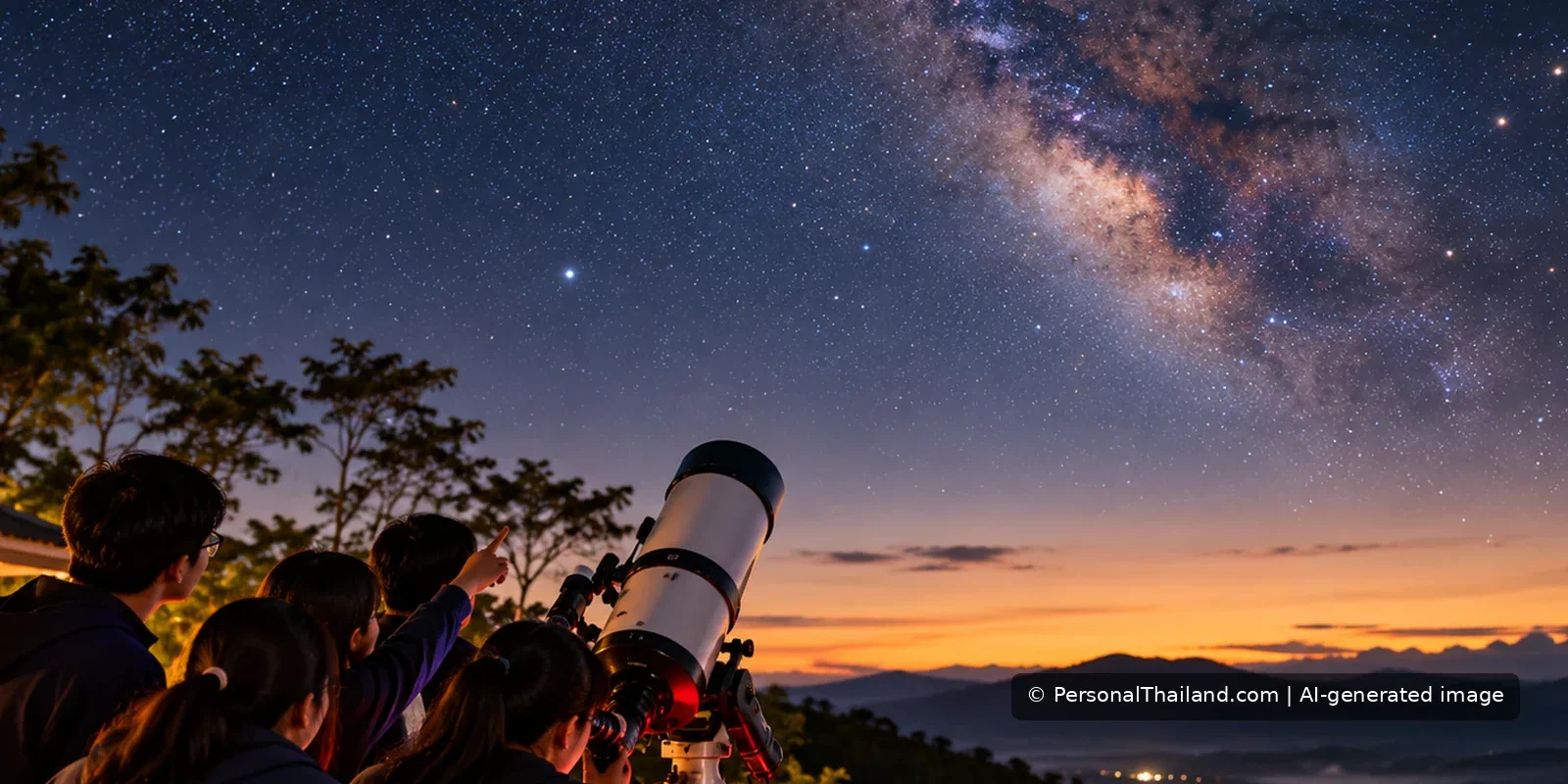
Astronomy is more than recognizing constellations. Olympiad preparation typically joins concepts from physics, mathematics, celestial motion and practical observation. Successful students must explain how they reach an answer and use physical reasoning, rather than memorizing lists of astronomical objects.
- Celestial geometry: connecting objects’ apparent positions with time, latitude and the movement of the Earth.
- Physics: applying mechanics, energy, gravity, light and other principles to astronomical questions.
- Data interpretation: reading measurements, estimating uncertainties and checking whether a numerical answer makes sense.
- Observation: practising careful identification and recording of the night sky and astronomical instruments where appropriate.
The precise exam format, permitted equipment and syllabus can change. Students should consult the current IOAA materials rather than treating a description of the first competition as today’s rules.
How Thailand’s team performed
POSN reports that Thailand’s team received three gold and two silver medals at the inaugural competition. The result belongs specifically to the 2007 IOAA. It is a useful example of what sustained training and university support can achieve, but it should not be interpreted as a forecast of results in another year.
Medals are only one part of an academic Olympiad’s impact. Students meet others with similar interests, experience new types of scientific questions and encounter the international character of research. Teachers can also share training methods and learn how other education systems approach the subject.
Interested in studying astronomy in Thailand?
For a school student, the practical starting point is a strong foundation in mathematics and physics. The next step is to explore the official Thai academic Olympiad pathway. POSN publishes information about astronomy centres, student selection and training programmes. Application windows and selection details may change, so verify the current announcement directly.
Students can make progress independently by keeping an observation notebook, following astronomy lectures, solving past conceptual problems and discussing unfamiliar ideas with teachers. Public planetarium activities and university outreach may also provide opportunities to learn, but should be checked against current schedules.
Parents should distinguish recognised academic programmes from commercial services that promise admission or medals. No summer camp, tutoring package or telescope purchase can guarantee an Olympiad position. The most valuable support is time, access to good instruction and encouragement to ask difficult questions.
Why this 2007 event still matters
Older travel and news posts often become irrelevant because they list yesterday’s times and contact details. Here, the opposite is true: the original announcement points to a genuine milestone in Thai science education. The founding of the IOAA in Chiang Mai showed that Thailand could do more than send students to international contests; it could help organise and shape one.
To explore the original history, consult the official IOAA history. For the Thai training background, use POSN’s explanation of the programme. Both are more reliable for this purpose than an obsolete 2007 phone number or email address.