
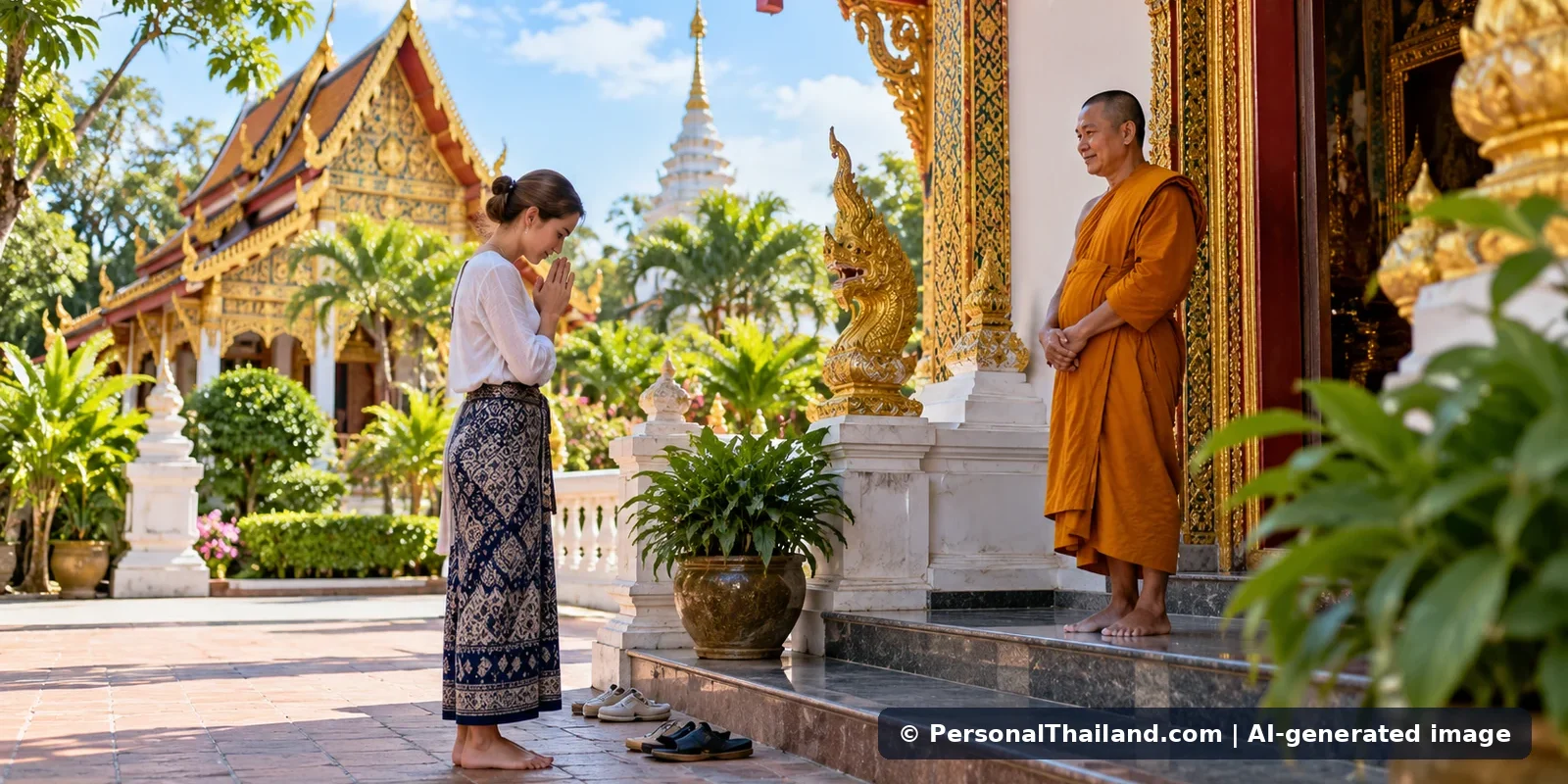
Thailand is welcoming to visitors, but everyday manners still matter. An old PersonalThailand article from 2006 reacted to a proposed etiquette booklet and mixed satire with sweeping claims about Thai people. Those jokes were never a dependable list of official rules. This updated guide replaces them with practical ways to show respect in temples, homes, transport and public life.
Updated: October 2026.
Start with observation rather than a rigid checklist
There is no single script for every encounter in Thailand. Customs can vary by generation, family, workplace and region, and Thai people do not all have the same religious beliefs. Watch what others are doing and listen to a host or venue staff member. Courtesy, patience and a genuine attempt to understand the situation matter more than flawlessly performing a gesture.
A polite smile and a calm tone go a long way, especially when language is limited. If a misunderstanding develops, raising your voice in a shop or at a counter rarely helps. Briefly explain the issue, show any receipt or booking reference, and allow the other person time to check.
The wai: useful to know, not compulsory in every situation
The wai joins the palms in front of the body with a slight bow of the head. It is a well-known sign of greeting and respect, yet its form and appropriateness depend on age, status and context. Tourists need not initiate an elaborate wai every time someone serves them in a café or hotel.
If someone welcomes you with a wai, a simple return gesture or a friendly verbal greeting can be appropriate. Avoid turning the wai into a photo opportunity or demanding that someone demonstrate it. Let your host guide you during formal ceremonies.
Temple clothing and quiet behaviour
Thai temples are living places of worship, not simply tourist attractions. Official Thai government guidance recommends modest clothing, removing shoes before entering designated halls, staying quiet and respecting signs that restrict photography. Different temples can set different entry procedures, so prepare for the stricter rules at major sites rather than assuming the dress code is identical everywhere.
- Wear clothing that covers the shoulders and is not revealing; long trousers or a modest skirt make temple visits easier.
- Take off shoes when asked or before entering a prayer hall where shoes are clearly left outside.
- Keep the telephone silent and never obstruct people who are praying or making offerings.
- Do not climb on Buddha images, pose disrespectfully beside them or touch religious objects without permission.
- Follow posted instructions about photography and access to areas reserved for worshippers.
According to the Tourism Authority of Thailand, visitors should also avoid pointing their feet at Buddha images when seated. A useful rule is to fold your legs to the side or sit in a position that does not aim the soles of your feet toward an altar.
Shoes, homes and personal space
Many Thai homes and some small businesses expect shoes to be removed at the entrance. Look for a row of shoes, ask politely and follow the host’s example. The practical point is cleanliness and respect, not a universal legal rule.
Avoid touching a stranger’s head, including a child’s, just because you find the child charming. Also be thoughtful when pointing with your feet or stepping over another person’s belongings. Context matters, but it costs nothing to ask before handling someone’s property.
Respect in markets, restaurants and public transport
You can ask a seller about prices without assuming everyone wants to bargain. Some stalls quote a fixed price; others expect polite negotiation. Check the displayed price or ask first. Keep queues orderly, respect workers and avoid blocking doorways to take photographs.
If food arrives differently from what you expected, explain the problem politely rather than describing it as dishonest behaviour. If there is a genuine consumer dispute, preserve documentation and seek the appropriate complaint channel instead of turning a single interaction into a claim about a whole country.
What the 2006 story should not be used to prove
The old article listed exaggerated fines, alleged bribery, stereotypes about neighbouring nationalities and claims that all Thai businesses or officials behave in the same way. Those statements were opinion and satire, not verified official guidance. A visitor should never rely on them as statements of current law or typical conduct.
A simple etiquette checklist
- Check each venue's dress and photography rules.
- Greet people calmly and accept that not every situation calls for a wai.
- Remove shoes where the host or signs indicate.
- Treat temples and other religious spaces as active places of worship.
- Ask before photographing individuals or entering private areas.
- Stay flexible: respect is a habit, not a collection of stereotypes.
The most useful travel habit is curiosity without entitlement. Thai etiquette is easier to learn when you are willing to observe, adapt and treat people as individuals. That approach is more accurate—and more enjoyable—than memorising a satirical list written nearly twenty years ago.




these people made things up
you guys might have done somthing wronf there … that’s why you get bad things back to you…
you DESERVED it ……..
such as STUPID DICK Headssss…..oh mannnnn
travelling far away from home need to be careful not just act like a stupid rich tourist…. you guys should learn to repect people there as well as their culture …alright?
and also as adult you should know where are an appropriate places to go and where are NOT … learn that stupid faces….
true indeed! You should send a copy to the minsitry for free distribution at schools, too.
Peter
Yes we will update the advice site later
Wow ,
yes all of this is true.
About the girls , 99.99% are ” Gold Diggers “.
They are trained by there parents , ” How to suck out a farang “.
Thats why the slogan : As smooth as Silk.
They know how to do it in a very smooth way.
And 1 advice never show your money or credit card.
Dirk