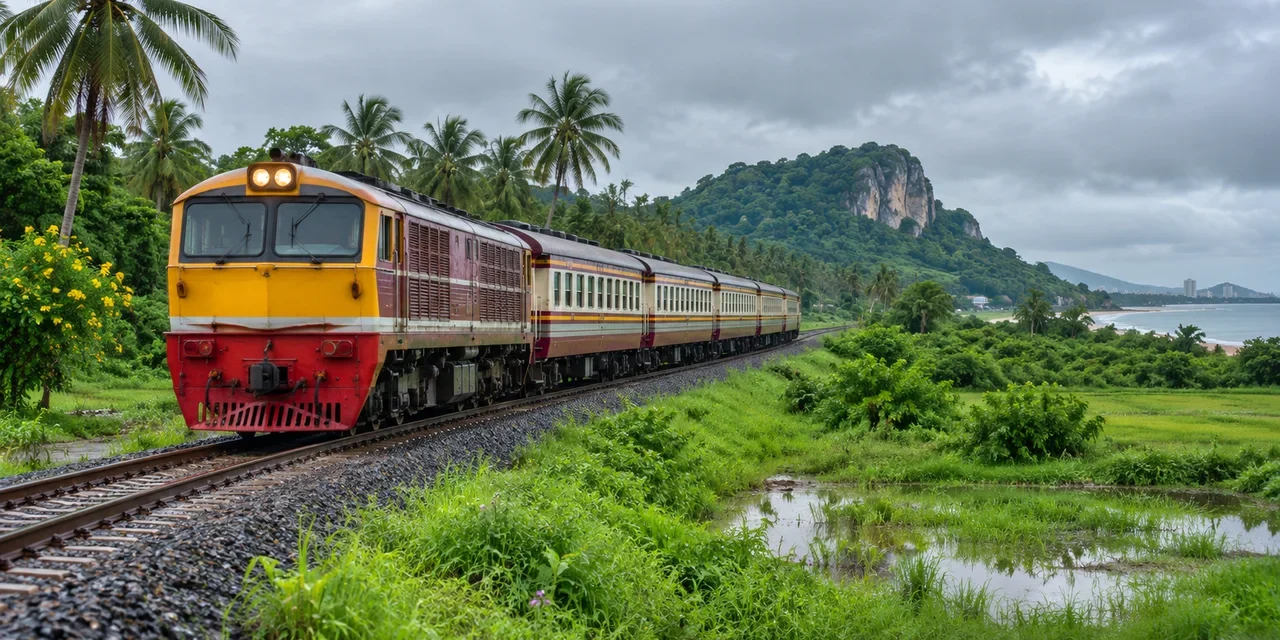
Train safety Thailand is a practical subject for travellers in every season, but this article began with a tragedy. In October 2009 a passenger train travelling from Trang towards Bangkok derailed south of Hua Hin during heavy rain. People died and many were injured. Their families deserve more than an old headline left online without context.
The earlier post described the service as travelling towards Trang. Contemporary reports describe the opposite direction. Early reports also gave different casualty totals, so I have not repeated a precise number here. Rain was reported at the time; that alone does not establish the cause of the crash.
Remembering the Hua Hin derailment
A railway accident is not just a disruption to a timetable. The people on that train were travelling for their own reasons, and a normal journey became an emergency. It is right to remember the event without turning the victims into a dramatic travel story or repeating details that cannot be confirmed.
At the time, news organisations reported heavy rain and quoted officials discussing the investigation. Accounts differed as information came in. I have removed the old hospital contact number: an emergency number from a historical report is not a reliable contact for a journey today.
Train safety Thailand: planning a journey today
Check the operator’s current timetable, departure station and booking arrangements before travelling. Keep your ticket and a copy of the booking where you can reach them, and give a trusted person the train number, route and expected arrival. This does not prevent an accident, but it can make communication easier when a journey is disrupted.
Allow enough time to reach the station without rushing across platforms. Station names and departure arrangements can be confusing to visitors, especially where a city has more than one station. If in doubt, ask official staff and confirm the information on your ticket.
Passengers with limited mobility, families with young children and anyone needing assistance should ask the operator in advance what facilities are available on the specific train and at both stations. A service that appears convenient on a map may still involve steps or a long transfer.
Rain and service changes
During heavy rain, flooding or severe weather, check the latest operator notices before leaving for the station and again before departure. Delays or changes to the route may be necessary. Avoid interpreting a photograph on social media as proof that your particular line is open or closed.
Keep water, necessary medicine and a charged phone with you in case of a delay. If you need medication at a fixed time, keep it in your hand luggage rather than a bag stored out of reach. Ask staff what assistance is available when plans change.
On the platform and aboard
Stand back from the platform edge and wait until the train has stopped before boarding. Use designated crossings and follow staff instructions. Wet surfaces can be slippery; give yourself time, especially when carrying luggage or helping another passenger.
On board, put bags where they cannot fall into the aisle. Notice the exits and any safety information provided by the operator. Keep valuables with you and avoid standing in open doorways. If there is an incident, listen to the crew and avoid moving onto tracks unless directed to do so or needed to get away from an immediate danger.
If a relative cannot be reached
Start with the operator’s current official contact channels and provide the train, date and passenger information. A person’s phone may be switched off or have no signal; try not to share speculation or a name publicly. If there is a confirmed emergency, follow information from responders and relevant authorities.
For immediate medical emergencies in Thailand, call 1669; police emergencies can be reported on 191. International visitors can also seek help from their embassy. For another travel perspective, see our airline safety guide and bus safety guide.
Tickets, staff and accessible information
Keep the operator’s booking confirmation rather than relying only on a message forwarded by a third party. If a train is cancelled, ask the operator which rebooking or refund conditions apply to your ticket. Those conditions can differ by service and may change, so check them rather than assuming that every booking has the same terms.
If a station announcement is difficult to understand, show your ticket to a member of staff and ask them to write down the platform or any change. Travellers who need step-free access should confirm the practical arrangements for their particular departure and arrival stations. A photograph of an accessible carriage elsewhere does not establish that the same facilities are on every service.
If someone needs immediate assistance while travelling, ask the train crew for help and contact emergency services where appropriate. In a disruption, let relatives know when you are safe; equally, avoid sharing photos of injured passengers or identifying information without a clear reason.
FAQ
Was rain confirmed as the cause of the Hua Hin derailment?
Reports say heavy rain was falling, but that fact alone does not establish the cause. This article does not claim a final investigative finding.
How can I check whether my train is running?
Consult the rail operator’s current official information or ask its staff before travelling, especially during severe weather.
What should I do if my train is delayed?
Follow the crew’s instructions, keep your travelling companions informed and ask the operator about onward arrangements.
When and where did the derailment happen?
It happened early on 5 October 2009, when an overnight train from Trang to Bangkok derailed near Khao Tao station, south of Hua Hin in Prachuap Khiri Khan province.
More from Personal Thailand
If you enjoy practical reporting and personal perspectives on Thailand, you can support my work and explore member-only content through either platform:
- Subscribe to Personal Thailand on X — creator membership with access to applicable subscriber-only posts and benefits.
- Join or support Personal Thailand on Buy Me a Coffee — browse available memberships and support options.
These are separate services with different charges and membership benefits. Paid access may be required; subscribing on one does not automatically grant access on the other. The main information in this article is free to read above.