Last checked: November 6, 2026. Rules can change; confirm the requirements that apply to your situation with the relevant official authority.
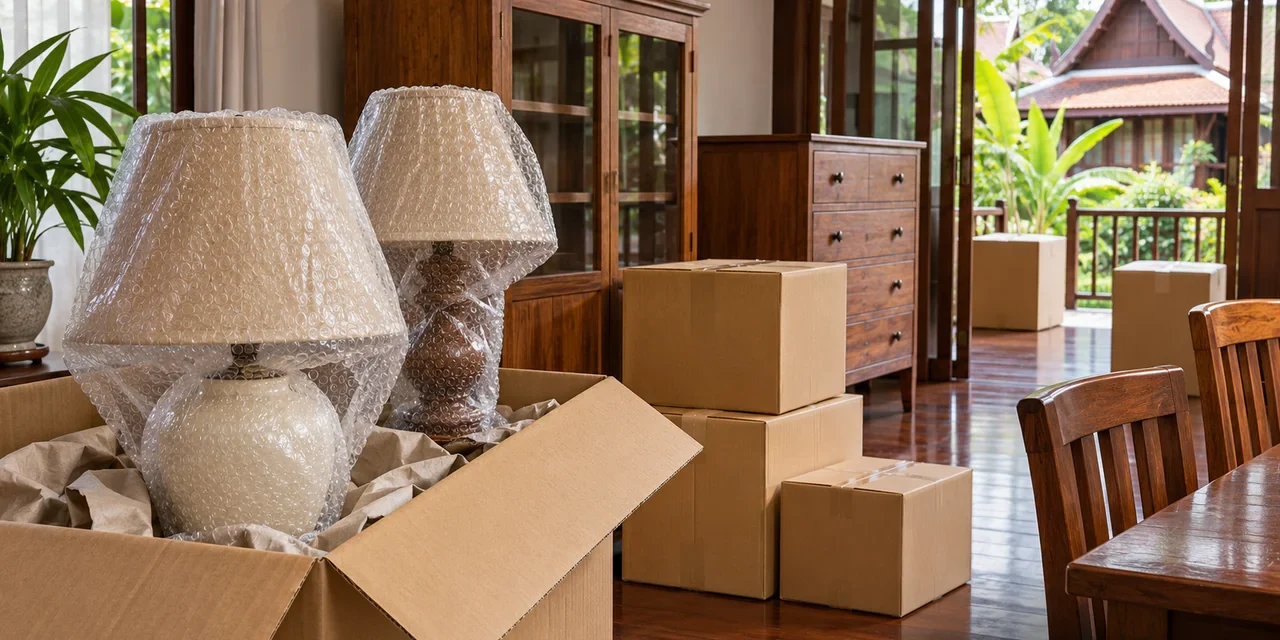
Moving household furniture and lighting to Thailand involves more than deciding whether a lamp will look good in the new house. The 2007 Personal Thailand article suggested buying items abroad and implied that household goods could generally enter tax-free if they were not for resale. Thai Customs describes a conditional allowance; personal use alone does not establish eligibility.
Moving household furniture and lighting to Thailand
Thai Customs says qualifying Thai and non-Thai people changing residence may be eligible to bring reasonable quantities of used household effects with relief from taxes and duties, subject to its criteria. Its guidance discusses ownership, possession and prior use abroad, as well as the person’s residence circumstances and required documents. New purchases made especially for the move should not be assumed to qualify as used effects.
The official guidance also describes timing and quantity conditions, including a general window around the owner’s arrival and limits for some electrical appliances. The treatment can depend on the type of item and whether the move is by an individual or family. The guidance lists possible residence documents for different categories of non-Thai applicants. These are eligibility criteria for customs purposes, not a general immigration guide.
Before shipping, ask Thai Customs or a qualified customs professional how the rules apply to your own status, arrival date, packing list and goods. A shipping company can explain its service and charges, but do not assume it can guarantee an exemption on Customs’ behalf. Restricted goods may require additional permission; ask about the particular item.
Compare the complete cost
Include the purchase price, packing, insurance, freight, clearance charges, any duties and taxes and delivery to the new home. Ask for a written quotation and what happens if a shipment is delayed or inspected. A bargain abroad can become expensive once the full journey is counted.
Consider the size of the doors, stairs and rooms at the destination, along with the risk of damage and the cost of replacement parts. There is no need to assume that Thailand lacks attractive lamps or furniture. Compare the item you already own with suitable local options and decide which has enough practical or personal value to move.
Check electrical suitability
For a lamp or powered furniture, check the manufacturer’s label for voltage, frequency and any power-supply requirements relevant to the place where it will be used. Plug shape is only one part of compatibility. A qualified electrician can advise about installation and safety, particularly for fixed wiring. Do not connect unfamiliar equipment simply because an adaptor fits.
Keep a clear inventory and supporting records of the items you are moving. For a broader decision about where to live, see our Spain and Thailand comparison. Our article on returning to the UK considers a different move.
Timing and the customs paperwork
Thai Customs’ published guidance describes a general arrival window for used household effects: not earlier than one month before or later than six months after the owner’s arrival, with possible extensions in exceptional circumstances. The same guidance describes limits on the number of certain electrical appliances, with different allowances for a family move. These are conditions in the published guidance, not a guarantee that a particular shipment qualifies.
Ask the authority to confirm the current requirements and which documents apply to your case before making a booking. A packing list, transport documents and evidence of the move may be relevant. If an item does not qualify, ask how applicable charges will be calculated. Do not understate the contents or value of a shipment.
FAQ
Is everything brought for personal use tax-free?
No. Any relief depends on the applicable customs criteria and the individual shipment.
Do newly purchased items automatically qualify as used household effects?
No. Thai Customs describes conditions including prior ownership and use abroad.
Does a plug adaptor prove an appliance is compatible?
No. Check electrical specifications and seek qualified advice where necessary.
Who decides whether an exemption applies?
Thai Customs assesses the application and supporting documents under the applicable rules.
More from Personal Thailand
If you enjoy practical reporting and personal perspectives on Thailand, you can support my work and explore member-only content through either platform:
- Subscribe to Personal Thailand on X — creator membership with access to applicable subscriber-only posts and benefits.
- Join or support Personal Thailand on Buy Me a Coffee — browse available memberships and support options.
These are separate services with different charges and membership benefits. Paid access may be required; subscribing on one does not automatically grant access on the other. The main information in this article is free to read above.