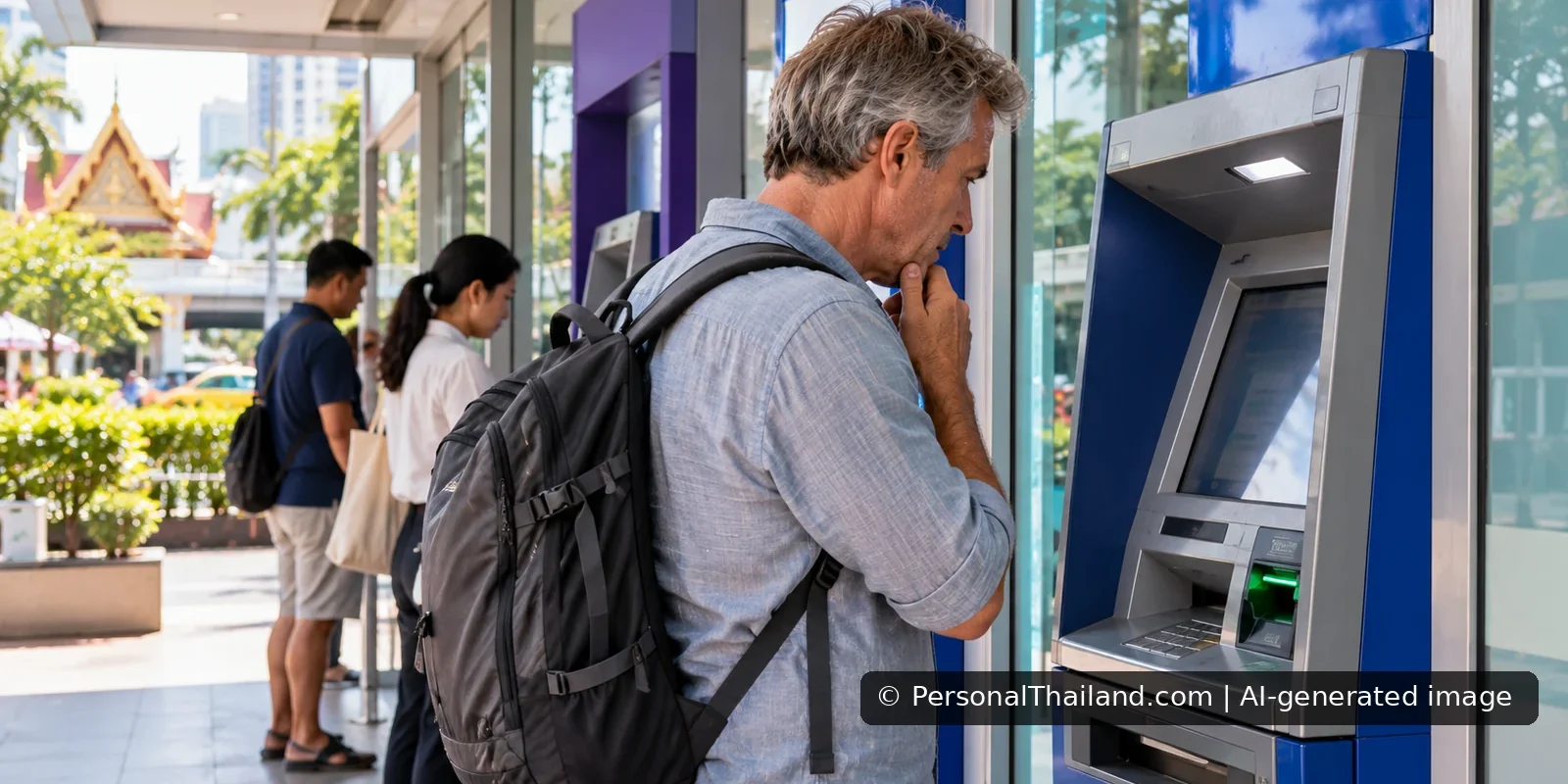
Banking costs in Thailand are easier to understand when you separate three things: what the Thai bank charges, what your own bank charges, and what happens when one currency is converted into another. Treating them as a single “ATM fee” can make an otherwise ordinary withdrawal look mysterious. This guide explains the moving parts without relying on a fee figure from years ago.
Charges depend on the bank, the account or card, the transaction, and sometimes the channel or region involved. A rule that was true for one bank in 2007 is not a safe description of how every Thai bank operates today. The practical approach is to read the current schedule, look at the on-screen disclosure, and compare total costs rather than a headline fee.
What can an overseas ATM withdrawal cost?
A cash withdrawal with a card issued outside Thailand can involve several separate charges. The ATM operator may apply a local access fee. Your card issuer may impose its own international withdrawal or cash-advance fee. In addition, you may pay for converting your home currency into Thai baht. The existence and size of each charge depends on the card, provider and transaction.
Read the ATM screen before confirming. If a local fee appears, decide whether the amount of cash you need justifies it, and keep the transaction record. Do not assume that an operator was free last year or that a particular chain always waives charges. Your home bank's tariff matters just as much as the Thai ATM's tariff.
Currency conversion is a separate decision
Some machines and card terminals offer to charge your home currency instead of Thai baht. This is called dynamic currency conversion, or DCC. Visa explains that the offer should disclose the exchange rate and any applicable markup, and that cardholders should be allowed to accept or decline it. An ATM's currency-conversion offer does not remove ordinary ATM-operator fees.
For a useful comparison, note the baht amount, the suggested conversion, and the rate or markup that appears. Ask your card issuer how it handles transactions charged in baht. Declining a conversion offer is often worth considering, but you should compare the terms of your own card rather than rely on a universal savings claim.
Local bank accounts: compare the product, not the rumour
A bank account involves different charges from a foreign-card withdrawal. Relevant items may include account maintenance, card issuance and renewal, replacement cards, printed statements, transfers and branch services. The Bank of Thailand maintains comparison tools (in Thai) covering deposit-service fees and debit-card fees, including charges for using ATMs in another region; its comparison pages also remind users that providers should be contacted about specifics.
Foreign residents should ask the intended bank what identification, residence information and account-purpose documentation it needs for their circumstances. Opening requirements can differ by product, bank and applicant. A blanket claim that foreigners categorically cannot open a savings account is not dependable guidance, just as a blanket promise that every visitor can open one immediately would be misleading.
Transfers and cash deposits need their own checks
A transfer through a banking app may have a different price from a branch transfer, and domestic payments should not be confused with international remittances. When sending money across borders, ask about the sending fee, receiving or intermediary charges, delivery currency and final amount expected to arrive. A low advertised transfer fee alone is not proof that the full transaction is inexpensive.
People living between Bangkok, Pattaya and other provinces should also confirm whether a particular branch service attracts an out-of-area charge. Rather than carrying forward an old “another-city deposit” example, look up the current tariff for the exact service you plan to use.
A practical five-minute comparison
Before withdrawing a substantial amount, review your home bank's foreign ATM conditions, identify any overseas cash-withdrawal limits, and check whether the Thai machine displays a separate local charge. Do not cancel and retry repeatedly if a machine has already shown that it is processing the transaction. A genuine uncertainty or missing cash should be reported to the bank promptly.
If you are comparing accounts, write down the card fee, maintenance conditions, transfer channels and international-service costs. For a short holiday, a familiar existing card may be enough; for longer residence, the convenience of local banking may justify comparing accounts. Neither route is automatically cheapest for everyone.
Safety, records and disputes
Use ATMs attached to staffed banks or other well-lit places where practical, shield your PIN, and avoid assistance from strangers. Keep notifications active and report a retained card or unauthorized transaction quickly to the issuing bank. Review receipts and app notifications, remembering that your home bank may show a settled amount later than the ATM displays it.
Thailand's central bank describes a financial-consumer protection channel, including its FCC 1213 service, for advice and complaints about regulated financial services. Usually you should begin by contacting the specific bank or card issuer so it can investigate the transaction with the necessary reference numbers.
Bottom line
Thai bank charges are not one fixed nationwide amount. Check the right category of fee, see whether DCC is being offered, and compare the costs from both banks before you commit. For current product conditions, use official fee tables and your bank's own published tariff rather than relying on a dated travel-forum post.