
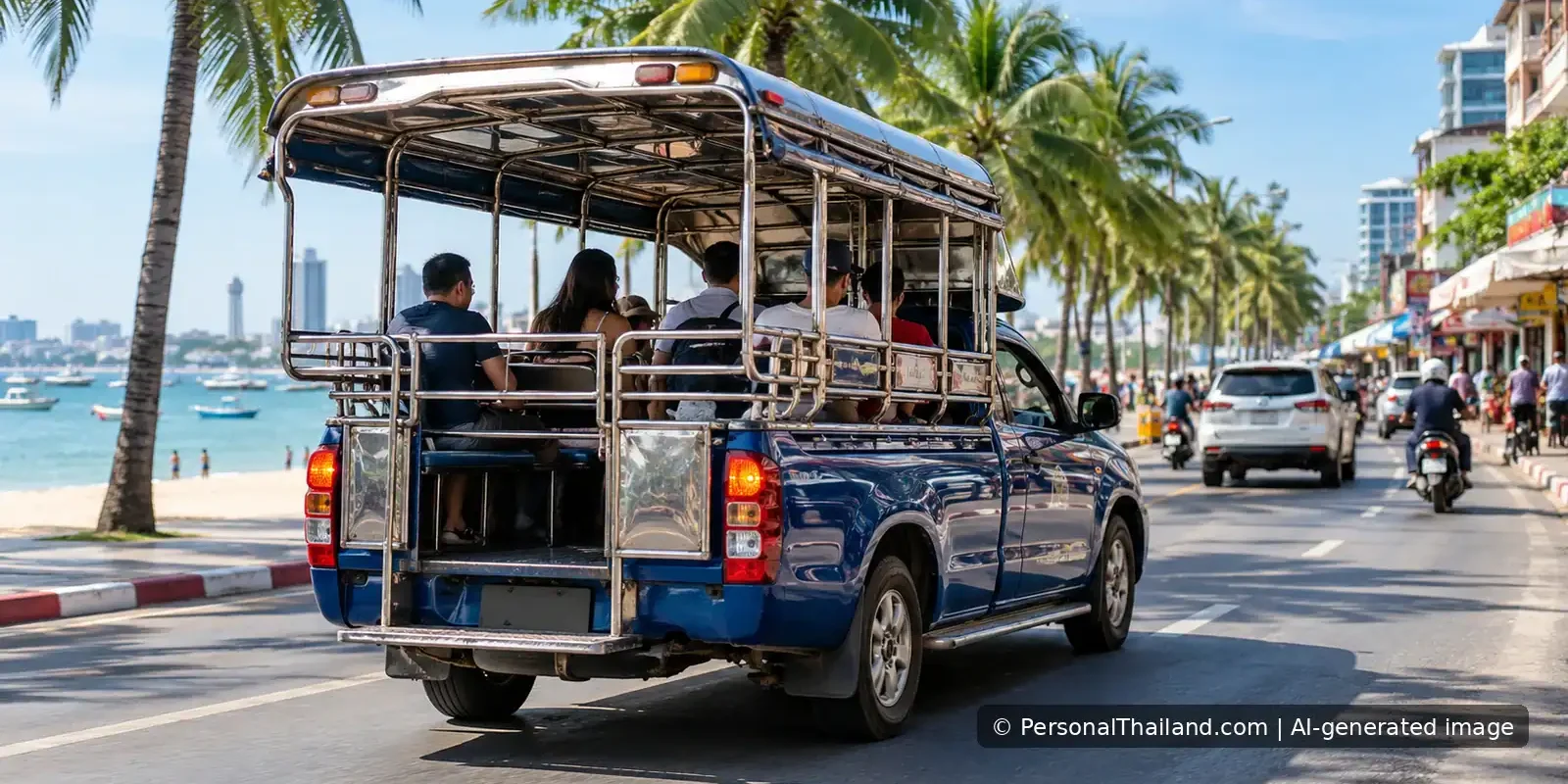
Pattaya’s blue songthaews, often called baht buses, are one of the city’s most familiar ways to get around. They are pickup-style vehicles with passenger benches in the back, used for shared journeys along busy roads. For a newcomer they can look like informal taxis, but the distinction between joining a shared route and hiring a vehicle privately makes a practical difference.
A PersonalThailand post from July 2009 complained about congestion caused by vehicles stopping to collect passengers. It also described possible confrontations with drivers, but these were personal assertions rather than a measured traffic study or an established pattern of violence. This updated guide focuses on how songthaews work, how to travel with consideration for others and how to avoid misunderstanding a fare.
What is a Pattaya baht bus?
The Thai word songthaew refers to a shared passenger vehicle with rows of seats. In Pattaya, blue songthaews are a common feature of the local transport system. They may take passengers along a familiar route or operate as a privately hired vehicle, depending on the arrangement with the driver.
The Tourism Authority of Thailand’s Pattaya destination guide describes a resort city with beaches, shopping, restaurants and attractions spread across different neighbourhoods. A traveller moving between central Pattaya, Jomtien and Naklua should plan how these areas connect rather than assume that one vehicle goes everywhere.
Shared ride or private charter?
On a shared route, several passengers can get on or off as the vehicle follows its usual direction. A charter is a separate arrangement in which the driver agrees to take a group to a specific destination, often for a different total price. Confusion happens when a visitor asks for a special detour and assumes it will cost the same as simply taking an available seat.
A local Pattaya songthaew guide describes the usual pattern: signal a vehicle travelling in the right direction, board when it is safe and use the buzzer when you want to stop. Discuss and agree on the total price before departure if you are requesting a private ride. Do not treat old prices from a 2009 article as current fares.
Understand the main central roads
Beach Road and Pattaya Second Road form an important part of the central city network. One-way traffic patterns matter, so a vehicle moving along Beach Road may not take you back in the opposite direction on the same street. Study a map before boarding, especially if you are unfamiliar with the area around Walking Street or North Pattaya.
Travellers heading to Jomtien or Naklua may need a different route or a transfer. Not every vehicle follows the same loop all day, and a driver’s last run can end earlier than a passenger expects. Where a connection is uncertain, ask a local information desk or choose a registered ride-hailing service with a clearly displayed fare.
How to ride with less confusion
- Stand somewhere safe where a vehicle can pull over without forcing other road users to make a sudden manoeuvre.
- Check the direction of travel before boarding, especially on one-way streets.
- Hold the handrails and keep your feet, bags and children securely inside the passenger area.
- Press the bell or buzzer in time for the driver to stop at an appropriate place.
- Use small banknotes or coins when possible, and pay the correct fare after confirming whether it was a shared ride or a charter.
Fares, routes and operating times can change, including during high season, roadworks and major festivals. Public travel sites disagree about some specific fare figures, so a single amount should not be presented as a permanent citywide rule. Check locally before relying on a price or late-night connection.
What about traffic congestion?
Shared vehicles need places to collect and discharge passengers. When stops happen in unsuitable locations, they can slow traffic or create hazards for pedestrians and motorcycles. But it would be unfair to blame every Pattaya delay on songthaews alone. Private vehicles, delivery traffic, roadworks, events and the city’s street layout all influence congestion.
Drivers and passengers both have responsibilities. Passengers should not demand an unsafe stop in moving traffic, and drivers should avoid blocking junctions, crossings or narrow access points. If a vehicle cannot pull in safely, waiting for the next opportunity is better than stepping directly into a lane.
Night travel, rain and heavy luggage
After dark or in heavy rain, an open-sided vehicle may be less comfortable than a car. Think about where you will be dropped off, whether the pavement is well lit and how far you must walk. A traveller with a pram, mobility limitation or large suitcase may prefer transport that provides a more suitable boarding arrangement.
Be alert to traffic when stepping down. Do not jump from a moving vehicle and do not leave possessions behind while paying at the driver’s window. In busy tourist areas, keep phones and wallets secured without treating fellow passengers as suspects.
Handling a disagreement over the fare
If a fare dispute arises, stay calm and ask for clarification rather than arguing in the road. Record the vehicle details privately if safe to do so, and seek help through an official channel if there is intimidation or a serious incident. The Thailand Tourist Police offers a visitor assistance service.
Pattaya’s baht buses are part of everyday life, not simply an obstacle to motorists. Using the shared system correctly and treating the street as a shared space makes local travel easier for visitors, residents and drivers alike.





Someone should do something about the Tuk Tuks ! I agree 100%