
Editorial update: 17 October 2026. This modern travel guide replaces an older historical article; opening hours, admission, transport schedules and weather may change.
Udon Thani is a useful gateway to Thailand’s northeastern Isan region, but it deserves attention in its own right. Visitors can combine a city stay with an important prehistoric site, seasonal lake scenery, temples, local food and the heritage of communities that have made the city their home. The result is a trip with more variety than a simple overnight stop.
Older travel articles often repeat dramatic claims about the very first civilisation or precise ancient dates. Those claims need careful archaeological context. The enduring fact is that Ban Chiang is a UNESCO World Heritage property in Udon Thani province, and its protected archaeological record offers a meaningful place to learn about Thailand’s prehistory.
At a glance: Explore Udon Thani in Isan: UNESCO-listed Ban Chiang, Nong Han lotus lake, Thai-Chinese heritage, temples and useful itinerary tips.
Ban Chiang: understand the UNESCO designation
UNESCO lists the Ban Chiang Archaeological Site as a cultural World Heritage property, inscribed in 1992. The site preserves evidence of prehistoric settlement, technology and everyday life in the region. A visit is most worthwhile when you read the museum explanations rather than racing through familiar pottery images. The featured image here is a conceptual illustration; it is not an image of an actual artefact recovered from the excavations.
Give the archaeological museum enough time
Ban Chiang is not simply a photogenic collection of red-painted vessels. Archaeological interpretation involves questions about settlement, burial practices, craft and chronology. Look for the museum’s current explanations of what has been found and what researchers can conclude. Historic sites often impose rules to protect fragile ground and exhibits. Stay on permitted paths and do not touch objects or remove stones, pottery fragments or other material.
The lake of pink water lilies
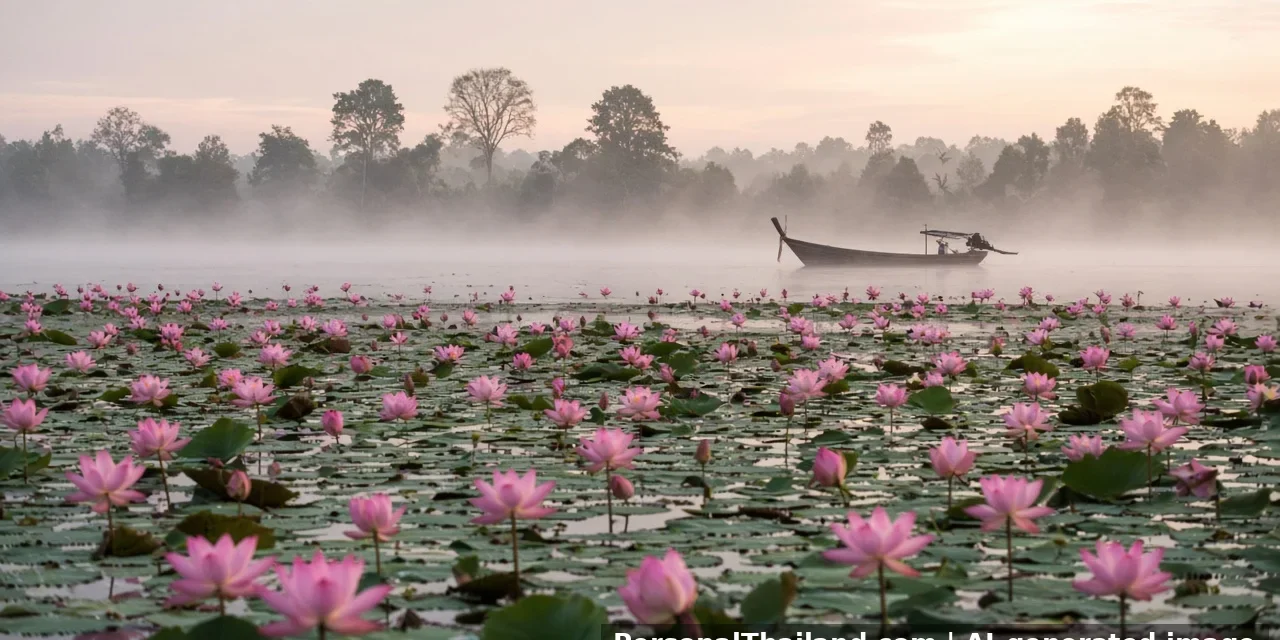
The Tourism Authority lists a pink water-lily lake around Nong Han in the Kumphawapi area among Udon Thani’s attractions. Blooming scenery is seasonal and conditions can vary from week to week; a beautiful social-media photograph cannot guarantee flowers on your travel date. Check local information before booking an early outing. If you use a boat, follow the operator’s safety instructions and choose a suitably equipped service.
A Thai-Chinese cultural stop
Udon Thani’s Thai-Chinese Cultural Center offers another part of the region’s story. The tourism authority describes its gardens, cultural displays and links with the Pu-Ya Shrine. It is a useful counterpoint to ancient archaeology because it shows how more recent communities have shaped the city. Be respectful around shrines, avoid interrupting prayers and do not assume that a ticket price or opening schedule from an older listing remains current.
The city as a practical base
Udon Thani city has accommodation, restaurants and transport options, but attractions are spread across different districts. Ban Chiang and the water-lily lake are not urban walking stops next to one another. Decide whether your priorities are historical sites, local food or seasonal nature, then plan travel time accordingly. A driver may be useful for a rural itinerary, though the full fare and waiting arrangements should be agreed before departure.
Markets, food and Isan hospitality
Northeastern Thai food is an important part of a trip to Udon Thani. Markets and casual eateries offer opportunities to try regional styles and observe everyday life. Chilli level, raw ingredients and fish sauce can be unexpected for some visitors; ask before ordering if you have allergies or dietary restrictions. Be courteous when photographing market vendors and remember that not everyone wants to be part of a travel video.
Crafts and textiles
The provincial tourism authority also highlights patterned textile traditions, including Pha Khid weaving. If you have time for a community craft visit, seek a workshop that welcomes visitors and explains the maker’s role. Avoid assuming all merchandise is handmade or locally produced. Asking about materials and making processes is more useful than bargaining over the smallest possible discount, and craft purchases should be voluntary rather than pressured.
How to organise a two-day visit
Use the first day for a city orientation, food, the Thai-Chinese centre and nearby cultural stops. On day two, choose either a longer archaeological outing to Ban Chiang or a seasonal nature outing near Nong Han, depending on your interest. Fitting both distant excursions into an overly tight schedule risks turning a rewarding visit into a series of rushed transfers. Extra time lets you explore villages and stop for lunch.
Before you travel
Confirm museum availability, current access rules and road or boat arrangements. For a lotus-focused trip, check whether flowers are actually blooming near your intended date. For Ban Chiang, read current museum information to distinguish established archaeological interpretation from broad historical claims repeated in older media.
Frequently asked questions
Is Ban Chiang a UNESCO World Heritage site?
Yes. UNESCO records its inscription in 1992.
Are the pink water lilies visible all year?
No reliable year-round bloom can be promised. Check current local conditions.
Can the city and Ban Chiang be explored on foot together?
No. The archaeological site is outside the city; plan transport.
Official sources and further reading
These verified source pages establish the location and attractions described. Always reconfirm changing visitor details with the destination or operator before travel.
- UNESCO World Heritage Centre — Ban Chiang Archaeological Site
- Tourism Authority of Thailand — Udon Thani province
- Tourism Authority of Thailand — Udonthani Thai-Chinese Cultural Center
Image disclosure: © PersonalThailand.com | AI-generated image. Featured imagery is an illustrative interpretation and should never be presented as a documentary photograph of a named site.







udon thani is a great little our should i say big city lots of places to stay the best for value is the top mansion 350 baht with air con newish hotel /guest house
check out my udon thani website
http://www.udonthani.co.uk/
Interesting post!
When we travelled up to Isaan we stayed outside of Udon Thani ina place called Gecko Villa and would definitely recommend it.
Not only does it get you out of the city, but you see a whole different side of Thjailand away from the tourist crowds, yet in complete comfort (this is a villa with a private pool rather than a hotel, and includes all meals cooked by the hosts who live a little while away.)
Check out their site at http://www.geckovilla.com