
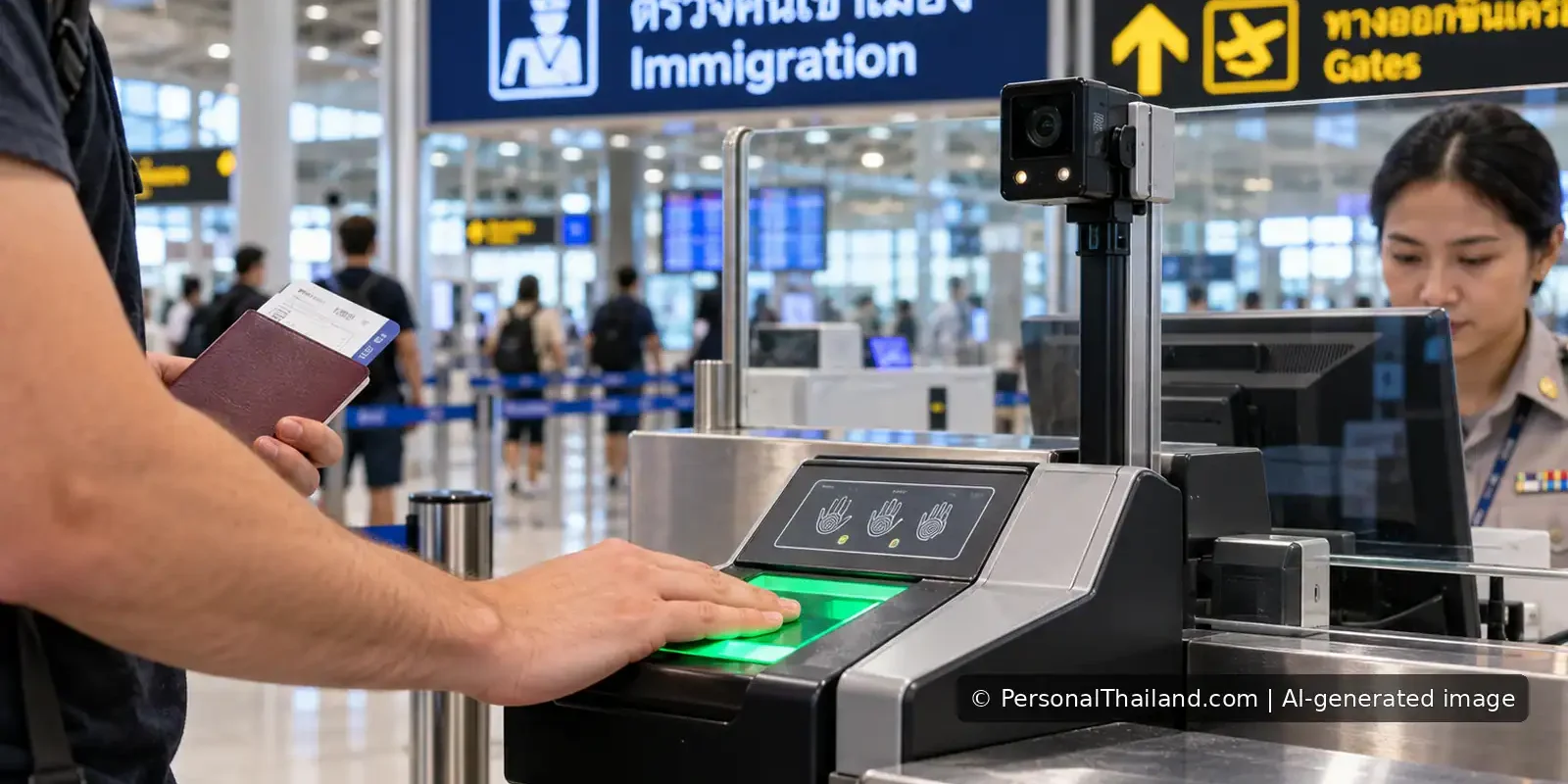
Airports and border agencies increasingly use electronic documents, fingerprints, photographs and facial recognition to check identity. Thailand has introduced several such systems over the years, but they are not all the same programme and they do not all apply to every visitor in the same way.
An August 2009 PersonalThailand article worried that Thai immigration would collect fingerprints from foreign travellers. It treated the policy as a universal measure and speculated that taking fingerprints from a person who had committed no crime must be unlawful. Such broad conclusions require legal evidence that the old article did not provide. A better modern guide explains what each system actually does and where to check its rules.
Biometrics are not simply fingerprints
Biometric information can describe measurable characteristics such as fingerprints or facial features. A passport may contain a digital photograph and other information on a chip. Border officers may compare the traveller with the identity record, while separate screening systems may check security or immigration databases.
Biometrics do not themselves decide whether a traveller has a valid visa or the right to enter. They help establish identity; visa rules, residence permission and entry decisions are legal and administrative questions. It is therefore important not to confuse a biometric scan with a visa approval.
Fingerprint checks in immigration services
Thai immigration offices also refer to biometric and electronic fingerprint systems in their public-service material for specified immigration processing. This supports the existence of fingerprint-related checks; it does not prove that every foreign person applying for every kind of visa must submit fingerprints in every setting.
Requirements can differ at a border crossing, a local immigration office, an overseas embassy or an automated airport gate. A traveller should follow the rules for the actual journey and the instructions of authorised officers, rather than rely on a single dramatic headline from 2009.
Facial recognition at Thai airports
The Thai government’s 2024 announcement described automated biometric identification for travellers at six major airports. The purpose was to help link check-in and boarding processes, using facial recognition after enrolment. The announcement distinguished domestic and international rollout dates.
Airline check-in systems and immigration border checks are separate procedures, even when both use a passport or facial image. Passengers should follow the airport’s current instructions because eligibility for an automated channel can vary with passport type, age, operational conditions and the specific lane being used.
The Digital Arrival Card is another system
The Thailand Digital Arrival Card (TDAC), introduced in 2025, replaced a paper arrival form for foreign travellers. The Tourism Authority of Thailand’s launch guidance explains that the process collects travel, accommodation and personal information for immigration registration.
Filling out an arrival card is not equivalent to obtaining a visa. It is also not necessarily the same as having fingerprints recorded or registering a face for an airport boarding system. Official portals and authorised agencies should be used for any required submission; people offering paid shortcuts through unfamiliar websites should be treated cautiously.
Privacy and personal information
Biometric information is sensitive because a fingerprint or facial pattern cannot be changed as easily as a password. Thailand’s official THIM privacy notice describes categories of personal and biometric data used in that application. A privacy notice helps explain the stated purpose and categories of information; it should not be mistaken for an analysis of every immigration database used in the country.
Travellers should read official explanations about collection, retention and contact channels where available. Do not send passport scans, fingerprints or face-verification photos to an unverified agent or through an unexpected private message.
Practical checklist before travelling
- Confirm your passport validity and the requirements for your nationality and entry category.
- Check whether a visa is needed; approval and entry are not the same as using an arrival form.
- Complete any required arrival registration through the official immigration channel.
- Allow time for manual document checks if you cannot use an automated gate.
- Keep your passport secure and retain official application confirmations.
- Ask authorised staff for help if a machine rejects your document; do not share private identity data with a bystander.
How to understand the 2009 fingerprint debate
The old story captured a moment when biometric screening felt new to many travellers. Since then, systems for identity verification have expanded and diversified. The useful question today is not whether every fingerprint check is a punishment, but which lawful process is involved, who operates it and what the published rules require.
Check official Thai immigration and airport updates close to your departure. Current eligibility and technology may change without making a decades-old report a reliable guide to entry today.






Well it is not the same system i think. Thai people do not give finger prints. Neither to Thai people travel to another country, maybe to USA but not to other countries. I understand that many countries will be doing this soon but maybe should start with their own population.
Fingerprints are now required not just for getting visas but also for e-passports. They’re part of what is called biometrics which also include facial and iris recognition.
The ICAO requires this.
Read this page for more info: http://en.wikipedia.org/wiki/EPassport