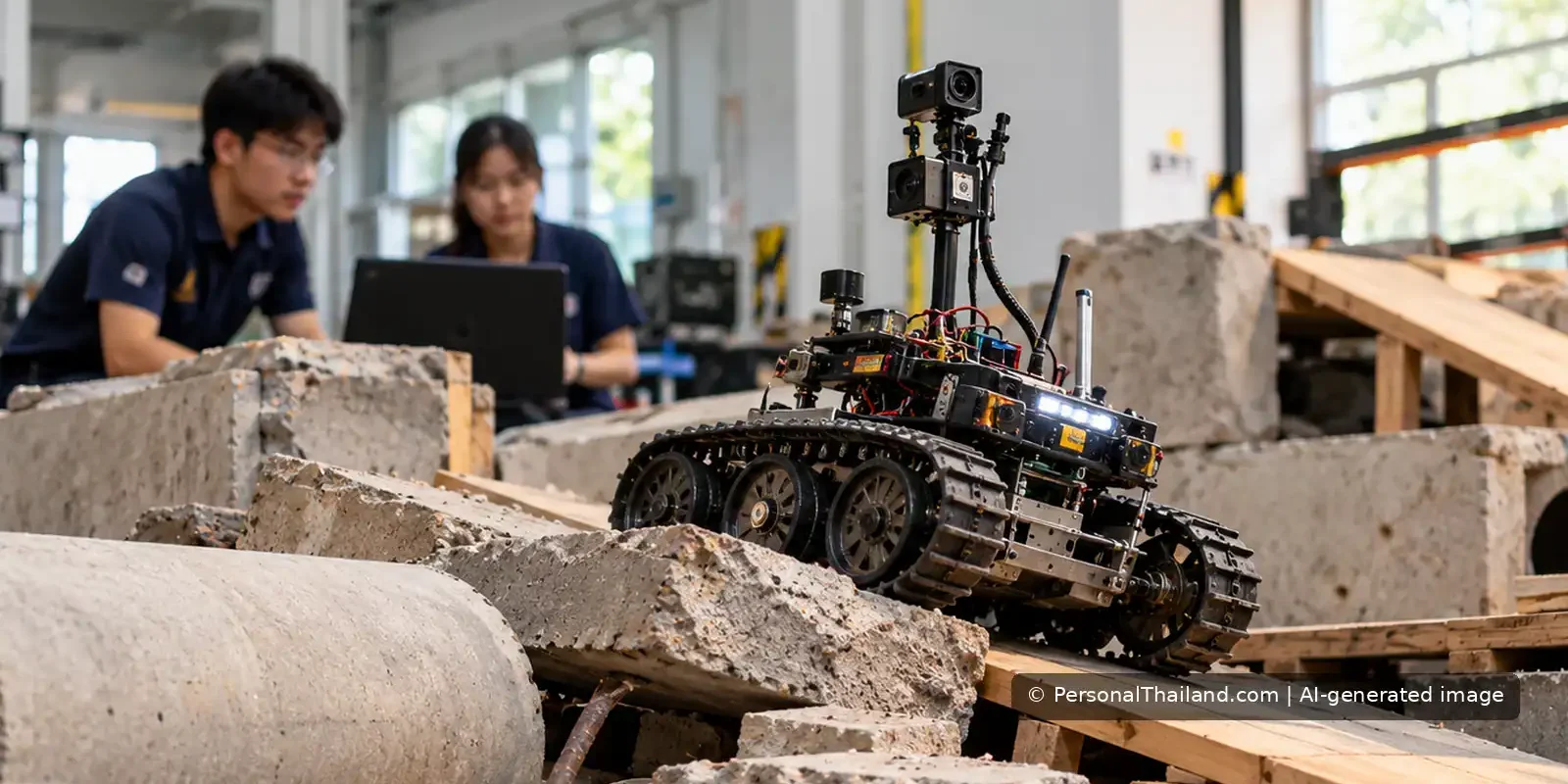
In 2007, a Thai student robotics team attracted attention for its performance at the international RoboCup Rescue competition in Atlanta, Georgia. The story is still worth revisiting, not because rescue robots have magically replaced emergency responders, but because it shows what students can learn when a difficult engineering problem becomes a real-world challenge.
What happened in Atlanta in 2007?
The original PersonalThailand report identified a team called CEO Mission from the University of the Thai Chamber of Commerce and described a third-place award in the rescue-robot competition. A historical overview indexed by the US National Institute of Standards and Technology (NIST) likewise identifies CEO Mission, the Thai university and a third-place award for 2007.
NIST’s archive of the 2007 event confirms that the RoboCupRescue world championship took place in Atlanta in July that year. The original news item was written several months later, in November 2007.
Competition records describe multiple robot leagues and award categories. Thailand’s RoboCup history also highlights the Independent team from King Mongkut’s University of Technology North Bangkok as a 2007 Rescue Robot League world champion. That does not necessarily conflict with an award to CEO Mission: a first-place overall result, a third-place recognition and other technical distinctions can be different achievements. Readers should avoid collapsing all of them into one ranking.
What is a rescue robot?
Rescue robots are designed to help teams inspect hazardous or hard-to-reach environments. A typical test may involve an obstacle course, unstable surfaces, narrow routes or mock disaster debris. The challenge is not only to move a machine from one point to another but also to gather reliable information without putting operators unnecessarily close to danger.
Robots may use cameras, lights, range sensors, tracked or wheeled mobility systems and radio communications. Their usefulness depends on the operating environment. A device that performs well on a flat laboratory floor may struggle with stairs, loose rubble, water or debris. That is why competitions often emphasise reliability and manoeuvrability rather than simply top speed.
Why student competitions matter
A student rescue-robot team must bring together multiple disciplines. Mechanical design determines whether the machine can balance and overcome obstacles. Electrical engineering affects power delivery and sensor reliability. Software helps combine control inputs with incoming information. Teamwork determines whether the robot is actually ready for a timed assessment.
The earlier report said the students built and refined their machine over several months. That is plausible as an account of their project, although the exact schedule and number of contributors were not independently verified from the event archive. The educational value, however, does not depend on the number of weeks claimed in a newspaper story.
Building a competition robot also introduces students to practical trade-offs. A larger battery may extend run time but increase weight. A camera mounted too high may improve one viewing angle while reducing stability. Powerful motors may consume more energy or complicate control in confined spaces. A successful design reconciles these tensions rather than maximising a single specification.
How a rescue-robot course tests judgment
- Mobility: can the robot cross uneven ground without becoming trapped?
- Observation: can the operator identify a target or hazard through the camera?
- Communication: does the connection remain usable around obstacles?
- Control: can the team recover after a poor manoeuvre or sensor failure?
- Safety: is the machine operated within the test rules and risk controls?
In an actual emergency, the stakes are very different from a competition. Human responders need suitable training, incident command, reliable communications and realistic deployment procedures. A student prototype that wins an award is not automatically a certified operational rescue system.
What happened to the team’s later plans?
The 2007 article speculated that students might develop equipment for detecting or disposing of dangerous objects. The available sources do not establish that those plans were completed or adopted by any Thai agency. This article therefore does not treat future intentions as historical achievements, and it does not describe unverified specialist hardware as an existing operational capability.
That distinction matters in technology reporting: a concept, a prototype, a contest entry and a deployed public-safety system are four very different stages. Each requires separate evidence.
Where to learn more about Thailand’s robotics story
NIST’s event archive offers a starting point for the international competition setting. The RoboCup Thailand history records achievements by Thai teams across several years and leagues. When researching a particular prize, always check the event year, competition category and award title rather than using the ambiguous phrase “world champion” for every result.
The enduring achievement of the Thai students in 2007 is the demonstration of technical ability on an international stage. For students today, the lesson is practical: complex robotics projects demand careful design, testing, documentation and teamwork. Those skills matter well beyond a competition trophy.