Last checked: 31 October 2026. Thai rules change often, so always confirm with the official source before you travel or apply.
This page once reported the deaths of two men based in Thailand who, while travelling in Cambodia, took heroin they reportedly believed was cocaine. The lesson reaches beyond that case. Whether the worry is fake medicine in Thailand, a dispensing mistake or a drug bought on the street, you cannot judge a substance by how it looks or by the seller’s word. I want to know the ingredient, strength and intended use, and who to contact if something seems wrong.
Updated 31 October 2026: This older page has been rewritten. Historical events and past advice should not be read as current alerts or rules. For our latest updates, follow @PersonalThai on X (Twitter). For decisions involving laws, visas, health or safety, also check the responsible authority.
Street drugs are not a medicine you can check
Illegal drugs have no label, no reliable dose and no one accountable for what is in them. A powder sold as one drug can be another, far stronger one, which is how a single dose can kill. Buying or using them is also a serious offence in Thailand and its neighbours.
If someone collapses, struggles to breathe or cannot be woken after taking anything, call 1669 straight away and tell the responders what may have been taken. Honest information helps them treat the person.
Fake medicine in Thailand is one of several different problems
A falsified medicine misrepresents what it is, while a substandard product fails relevant quality requirements. A genuine medicine can also be used incorrectly or cause an adverse reaction. These are not interchangeable explanations for someone becoming unwell.
The old article referred to deaths after the wrong drugs were taken. This rewrite does not repeat unverified medical conclusions or identify private individuals. It focuses on reducing preventable mistakes and obtaining help when a product or treatment raises concerns.
Do not diagnose counterfeit medicine simply because it looks different from a brand at home. Equally, convincing packaging does not prove authenticity. WHO warns that some falsified products closely resemble genuine ones, so the source and professional checks matter.
Use an identifiable, appropriate supplier
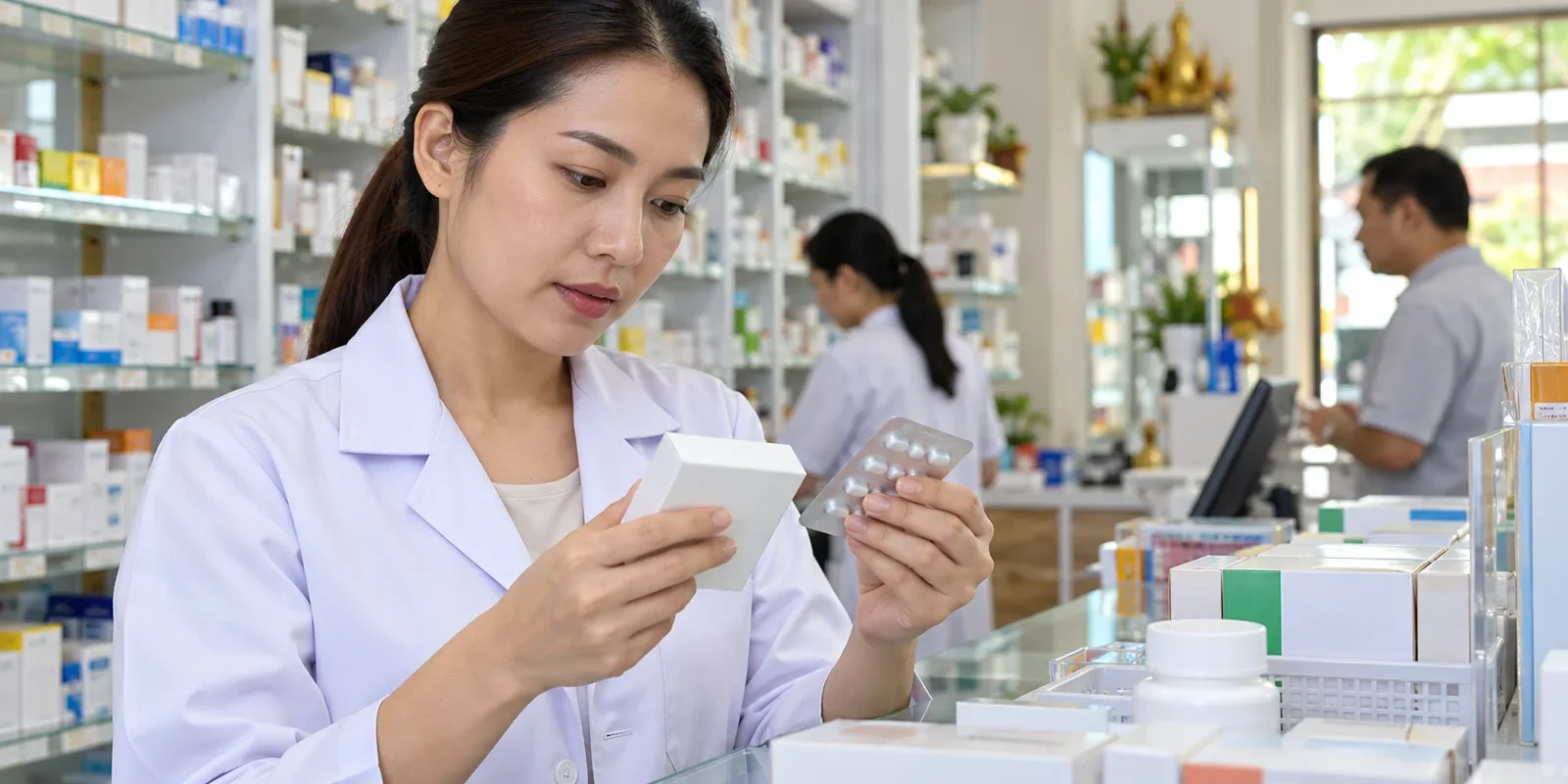
Choose a licensed pharmacy or established medical provider where you can speak to a qualified professional. Ask who is dispensing the medicine and explain what you need. An anonymous online seller or a message offering unusually cheap prescription products gives you far less ability to verify the supply.
Keep the receipt and the name of the outlet. If a product needs review later, those details connect it to the transaction. A loose tablet from a friend or an unlabelled packet from an unknown seller may leave a clinician unable to establish what was taken.
I would not use a shop’s confidence as a substitute for medical assessment when symptoms are persistent, severe or changing. A convenient purchase is not always the right next step. Ask when a doctor should review the problem rather than buying repeated courses of treatment.
Check the ingredient and strength
Read the active ingredient, amount per tablet or dose and the instructions. Ask the pharmacist to explain any difference from your usual medicine. Products with similar names can have different formulations, while different brands can contain the same ingredient.
Show the pharmacist your other medicines, including supplements and products bought without a prescription. Ask about duplication and interactions. Do not assume that an herbal label means a product is harmless or compatible with everything else you take.
If the instructions are unclear, ask for a written explanation you can understand. Repeat back how you plan to use the medicine so a misunderstanding can be corrected before you leave. This is particularly helpful when several products have been dispensed together.
Inspect packaging without overestimating what it proves
Look at the expiry date, batch information, seals and condition. Check whether details on the outer box and inner packaging match. If something looks damaged, altered or inconsistent, ask the pharmacist to investigate rather than trying to decide authenticity from a photograph alone.
Keep the packaging until the treatment is finished, especially if a concern arises. Do not pour several medicines into one unlabelled container for convenience. A tidy travel pouch is less useful if it removes the information needed to identify the contents.
WHO’s consumer guidance recommends discussing suspected quality problems with a health professional and reporting concerns to the national regulator. In Thailand, the Thai FDA is the relevant medicines authority. Ask for the current reporting route through its official service or the treating provider.
Store medicines as instructed
Read the storage requirements and ask if your accommodation or travel plans create a problem. A hot car, direct sun or a damp bathroom may be unsuitable for some products. Do not assume every medicine needs refrigeration either; follow the instructions for that particular product.
Keep medicines away from children and pets and separate them from food or cleaning products. If several people share a home or hotel room, label personal supplies clearly. A medicine that is appropriate for one person may be dangerous for another.
If a product has been exposed to unsuitable conditions, ask a pharmacist whether it remains usable. Guessing from appearance can be unreliable. Arrange a safe replacement where needed instead of quietly increasing the amount because you think the medicine has become weaker.
If you feel unwell after taking it
Seek medical advice promptly and explain the medicine, amount and timing as accurately as possible. Take the packaging and receipt if available. For severe symptoms such as collapse, breathing difficulty or inability to wake, call Thailand’s medical emergency number, 1669.
Do not keep taking extra doses to see whether the product eventually works. At the same time, do not abruptly stop essential long-term treatment without advice unless emergency professionals direct you. The right response depends on the medicine and the symptoms, so obtain a clinical assessment.
Keep the remaining product safely for review rather than returning it without any record or throwing it away immediately. A photograph of the label and batch details can help preserve information while you ask what should happen to the actual package.
Travelling with your own supply
Check Thai requirements before bringing medicines across the border. Controlled substances can require permits and supporting documents, and rules depend on the active ingredient and quantity. Mailing a refill is not automatically equivalent to carrying a lawful personal supply.
Read our broader Thailand safety guide when preparing for travel. For concerns about regular painkiller use, see seeking help with pain medicines. For medicine decisions, make an individual plan with a qualified professional.
FAQ
Can I identify fake medicine from the box alone?
Not reliably. Packaging checks can reveal concerns, but some falsified products closely resemble genuine ones. Use an appropriate supplier and ask a pharmacist or regulator to assess a suspected problem rather than relying only on online pictures.
Is a cheaper generic medicine necessarily suspicious?
No. Price and a different brand name do not establish poor quality. Confirm the active ingredient, strength, source and suitability with the pharmacist. An unexplained anonymous supply is a different issue from a properly dispensed generic.
Should I report a product that seems ineffective?
Discuss it with a clinician or pharmacist, especially if symptoms persist or worsen. Ineffectiveness can have several causes. Keep the product details so a suspected quality issue can be assessed and reported through the appropriate route.
Can I share leftover medicine with a friend?
Do not share prescribed treatment. Your friend’s condition, other medicines and risks may be different. Encourage them to obtain their own assessment and appropriate supply rather than trying to solve the problem with an unidentified or leftover product.
More from Personal Thailand
If you enjoy practical reporting and personal perspectives on Thailand, you can support my work and explore member-only content through either platform:
- Subscribe to Personal Thailand on X — creator membership with access to applicable subscriber-only posts and benefits.
- Join or support Personal Thailand on Buy Me a Coffee — browse available memberships and support options.
These are separate services with different charges and membership benefits. Paid access may be required; subscribing on one does not automatically grant access on the other. The main information in this article is free to read above.