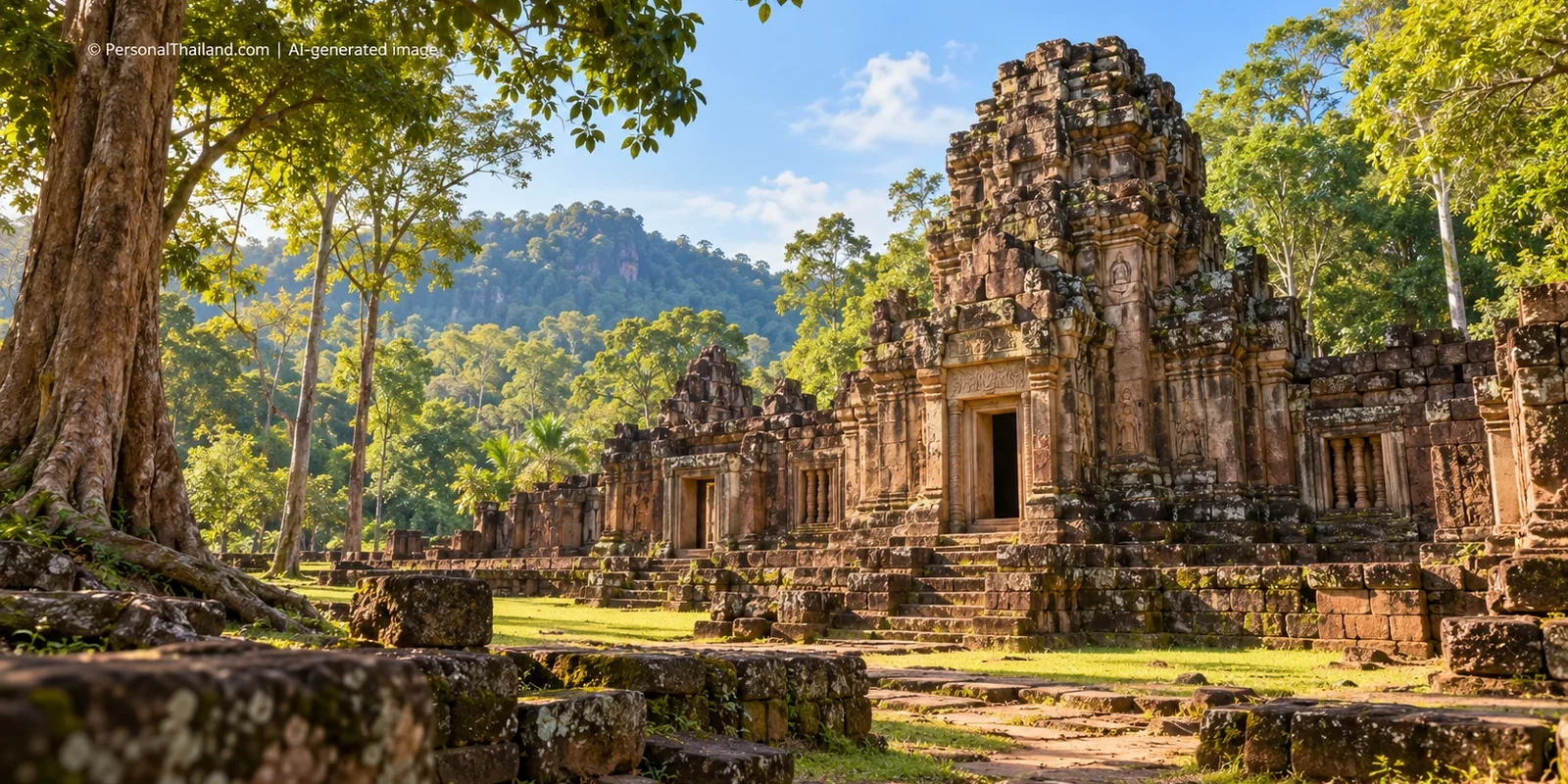
Prachin Buri offers a rewarding combination of ancient religious sites, agricultural landscapes and access to some of eastern Thailand’s protected forests. It is a useful destination for travellers interested in archaeology who also enjoy quieter provincial roads. Some older descriptions blur provincial boundaries or imply that the entire Khao Yai landscape lies in Prachin Buri, so it is important to distinguish the specific sites you intend to visit.
Sa Morakot and early Buddhist heritage
The Sa Morakot Archaeological Site in the Si Mahosot area is documented by the Tourism Authority of Thailand. It is associated with early Buddhist remains and large carved footprints in laterite. These are religious and archaeological objects that deserve respectful observation. Visitors should keep off protected masonry, avoid rubbing or touching carvings and follow current site access rules.
The Tourism Authority of Thailand dates the footprints to roughly the 7th–9th centuries CE, the Dvaravati period, rather than to a single calendar year. For more detail, rely on the site’s own interpretation and archaeological specialists rather than on precise dates repeated in older online posts.
Si Mahosot and the historical landscape
Si Mahosot is another name worth knowing when planning a heritage route. The wider area contains traces of earlier settlements and religious activity. Archaeological parks and small heritage sites may not have the same level of visitor facilities as a large national museum, so check practical arrangements before driving there.
The provincial visitor guide also names the Chao Phraya Abhaibhubejhr Building among recognised landmarks. As with any historic building associated with a current institution, public access may be limited to specific sections. Do not assume you can enter every part simply because a travel guide includes a photograph.
Forest scenery and protected parks
Prachin Buri is linked with the broader Dong Phayayen–Khao Yai forest landscape, including protected park areas that extend across multiple provinces. Khao Yai, Thap Lan and nearby conservation zones should not all be described as being wholly within Prachin Buri. Check the precise entrance, driving route and current management information for the area you choose.
Forests can mean steep terrain, rain, wildlife and changing trail conditions. Keep to designated routes and never approach or feed animals. An old price or park map is not a substitute for checking entrance rules with the relevant Department of National Parks office. Waterfalls and rivers may look inviting while currents or slippery rock create real hazards.
Rural life and regional food
Beyond the headline sights, Prachin Buri has active farming communities and provincial markets. Stop for a meal and take time to observe everyday activity without treating private land as a photography location. Locally grown produce changes with the season, and a roadside vendor may have a different selection from one visit to the next.
If your interests include herbs or traditional practices, distinguish local cultural knowledge from medical claims. Neither a museum display nor a herb shop should be presented as proof that a product treats a disease. Visitors with health concerns should use appropriate professional advice rather than relying on travel anecdotes.
Choose heritage or nature as your main day
A heritage-focused day can centre on Sa Morakot and nearby Si Mahosot. A separate day is more appropriate for a selected forest or national-park area, allowing for travel and current access checks. Trying to combine remote trails with archaeological stops in a single rushed afternoon reduces the experience and increases travel risks.
Confirm transport, permitted entrances and site opening conditions before setting off. Prachin Buri is most enjoyable when the history is approached carefully and the protected natural landscape is treated as a living environment, not an unlimited recreation ground.