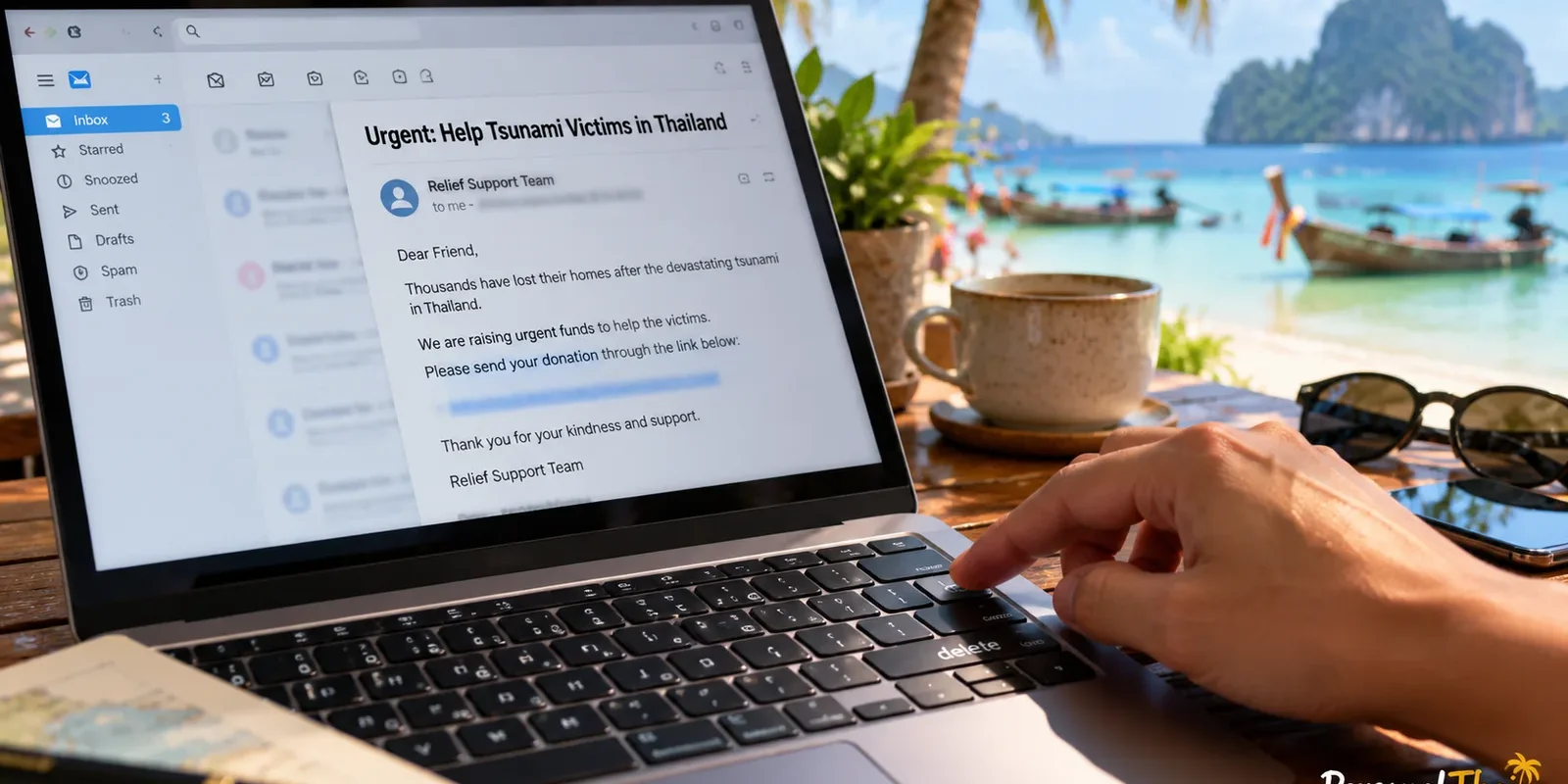
I want donations to reach people who need them, whether that means a family rebuilding after a flood or a community still recovering from a disaster. Tsunami donation scams exploit that same wish to help. The useful question is not where a supposed fundraiser comes from, but whether their identity, work and payment instructions stand up to checking.
Updated 31 October 2026: This older page has been rewritten. Historical events and past advice should not be read as current alerts or rules. For our latest updates, follow @PersonalThai on X (Twitter). For decisions involving laws, visas, health or safety, also check the responsible authority.
Why this older story needs a different approach
The Indian Ocean tsunami belongs to the history of this region; an old appeal is not evidence of an emergency happening today. Photographs and fundraising messages can circulate long after their original context disappears. Before sharing one, establish when the event happened and whether the organisation is still running the named project.
The former headline also attached a nationality to fraud. I would rather give readers checks that work against any dishonest appeal. An accent, passport or imperfect English tells you very little about whether money will reach the promised destination. A familiar local face is not a substitute for records either.
Tsunami donation scams: start with the work, not the payment button
Ask what the money will buy, where the work is happening and who will carry it out. A small group may have a modest website and still answer those questions clearly. A polished campaign may have plenty of photographs without explaining who controls the funds.
I find a concrete description easier to assess than an enormous promise: repairing a specified community kitchen, supplying materials to an identified school, or funding transport for an established relief partner. You do not need recipients’ private medical records or children’s identities to understand a project’s purpose.
Look for previous updates that show a sequence of activity. One photograph of donated supplies proves little about a long campaign. Ask whether the group can explain what happened after earlier collections, including delays or a change of plan. Honest work sometimes changes; unexplained changes deserve a pause.
Verify the organisation independently
Open the organisation’s website through a route you find yourself. Do not rely entirely on the link in an unsolicited message. Compare the campaign name, contact details and donation instructions with that independent source. If anything differs, ask through the established contact before transferring money.
Government consumer guidance warns that fraudsters imitate known charities and use names close to legitimate ones. This is a useful warning, but it does not mean that every new local project is fraudulent. It means you need enough information to make a decision rather than donating because a logo looks familiar.
If a friend forwarded the appeal, ask what they personally verified. “Someone sent it to me” is different from “I have worked with this group and confirmed this collection.” Treat a social-media share as the start of your research, not its conclusion.
Check the payment destination
Compare the recipient name with the explanation given by the fundraiser. If a personal account is used for a community collection, ask why, who keeps the records and how the organiser will account for spending. A personal account alone does not prove fraud, but an unexplained mismatch should stop the payment.
Before confirming a transfer, read the amount and recipient on your bank’s own screen. Keep the confirmation and the exact appeal you relied on. If your intention is a single donation, check that you have not selected a recurring payment. Do not send identity documents merely because an unverified fundraiser asks for them.
Never share a banking password, security code or remote access to your phone to make a donation. An organiser does not need to control your device to receive funds. For related precautions, see my guide to safer internet banking in Thailand.
Think before sending goods
Money and donated items solve different problems. Before buying blankets, food or medicines, ask the receiving organisation what it can actually use and store. Unrequested goods may create sorting and transport work at a time when people are already stretched.
Agree on quantities, delivery arrangements and who will receive the shipment. Avoid sending medicines through an informal appeal without a qualified organisation managing the process. For overseas parcels, my international shipping guide explains why contents and carrier rules need checking before anything is posted.
If you have already paid
Contact your bank or payment provider promptly through its official channel. Explain the transaction accurately and ask what action may still be available. A transfer cannot always be recovered, and no stranger can guarantee a refund simply because they know details of your payment.
Save messages, receipts, account details and the campaign address before blocking the sender. Write a short timeline while the facts are fresh. If you report suspected wrongdoing, separate what you saw from what you assume. A payment dispute, an unsuccessful project and deliberate deception are different claims.
Be wary of a second approach offering to recover the money for another fee. Do not let embarrassment push you into another rushed decision. Ask a trusted person to sit with you while you organise the evidence and contact the relevant provider or authority.
FAQ
Is a small Thai community fundraiser automatically unsafe?
No. Size is not a verdict. Ask the same practical questions about purpose, responsibility, payment details and reporting that you would ask a large organisation. A small project may explain its work very clearly without expensive promotional material.
Should I share an appeal before donating?
Verify it first. Sharing gives an appeal access to your friends’ trust, even if you never send money yourself. If you cannot establish the date or organiser, hold back rather than adding an urgent caption to an uncertain message.
Does a receipt prove the donation was used properly?
A receipt records a payment or acknowledgement. It does not by itself prove the promised work happened. Keep it, but also look for sensible follow-up reporting that respects recipients’ privacy and explains how funds were used.
Can I still help after a disaster leaves the headlines?
Yes. Recovery may require sustained support. Confirm the current project and ask what is needed now rather than assuming an old emergency shopping list still applies. A careful donation made next week can be more useful than a rushed one today.
More from Personal Thailand
If you enjoy practical reporting and personal perspectives on Thailand, you can support my work and explore member-only content through either platform:
- Subscribe to Personal Thailand on X — creator membership with access to applicable subscriber-only posts and benefits.
- Join or support Personal Thailand on Buy Me a Coffee — browse available memberships and support options.
These are separate services with different charges and membership benefits. Paid access may be required; subscribing on one does not automatically grant access on the other. The main information in this article is free to read above.