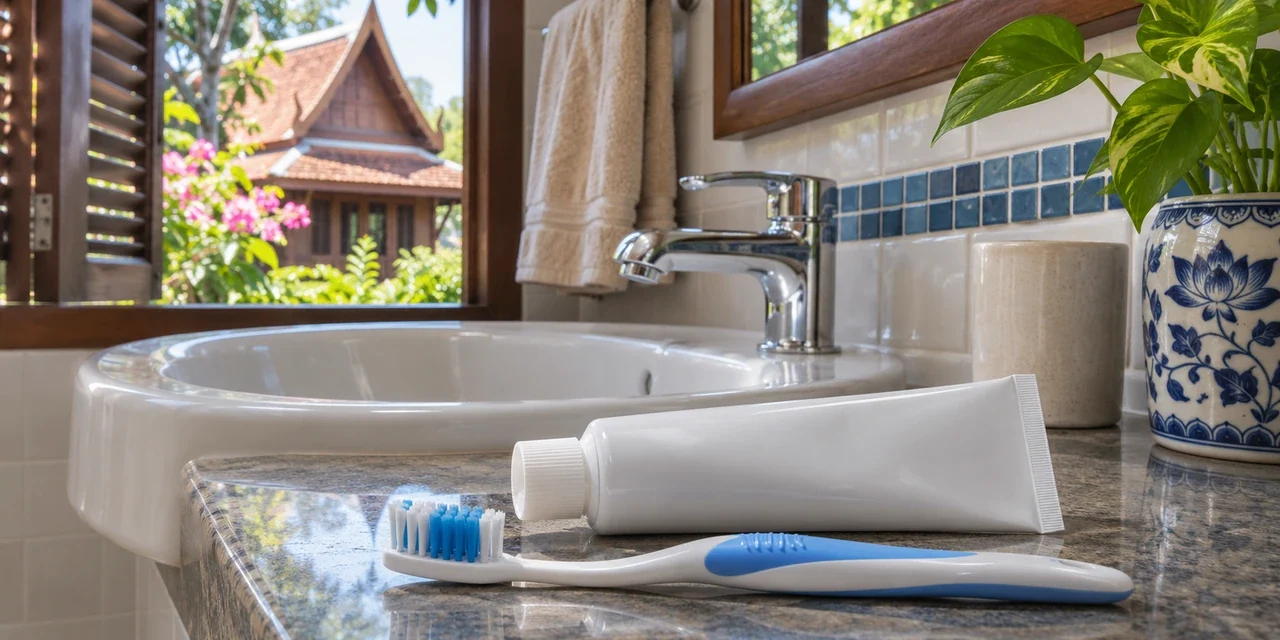
Toothpaste, triclosan and ants were an unusual combination in a 2006 Personal Thailand post. The old writer noticed ants around a bathroom sink after using a particular toothpaste and worried about an antibacterial ingredient. The observation is an anecdote, not a test of whether toothpaste is poisonous.
Toothpaste, triclosan and ants: what the old post said
The original account linked ants in the sink to an older Colgate Total formulation and listed several brands as either containing or not containing triclosan. Product formulas vary by product, market and time. A list from 2006 is not a reliable guide to the tube on a shelf today.
Triclosan was used in some toothpastes for antibacterial purposes. The American Dental Association describes its historical use in toothpaste in the United States. Colgate-Palmolive says it no longer used triclosan as an ingredient as of January 2019. Its policy explains that exit dates refer to the last manufacture date, not the day every older product disappeared from shops. Those sources are useful context; they do not establish the formula of every toothpaste sold in Thailand at every date.
The presence of an ingredient is a different question from the risk associated with its amount, exposure and use. Equally, an ant approaching a product does not tell us whether the product is safe or unsafe for a person. The old account did not measure ingredients, exposure or health outcomes.
How to check the tube you have
Look at the ingredient list on the actual package, including the market and product variant. If the label is missing, unclear or different from what you expected, ask a pharmacist or the manufacturer and retain the packaging. Do not assume a similarly named product from another country has an identical formula.
For dental care, a dentist can help you choose a suitable product for your own circumstances. If swallowing a product or experiencing a reaction is a concern, contact a health professional or an appropriate local poison-information service. Do not diagnose an exposure from insect behaviour.
To keep a bathroom clean, wipe residue from the sink and store toiletries according to their labels. Ants in a home can be a nuisance, but their presence is not a laboratory result. Our article on checking medicine authenticity discusses a different product-safety question. Our guide to checking cosmetics explains why labels and sources matter.
The old post grouped products by brand name, which can obscure differences between variants. Even a product with familiar packaging can be reformulated, and a list written for one market may not describe another. Keep the outer box or photograph the label if you need to discuss a product with a professional. A manufacturer’s general statement is useful background, but the label and batch of the item in your hand are the relevant starting point.
FAQ
Did ants prove the toothpaste was toxic?
No. The observation cannot establish a product’s ingredients, exposure or health effects.
Can I use the 2006 brand list today?
No. Formulas and availability can change; check the exact current product.
Did triclosan occur in toothpaste?
Yes, some past formulations contained it. That does not establish the contents of every current product.
Who can help me choose toothpaste?
Ask a dentist or pharmacist, especially if you have a particular sensitivity or health concern.
More from Personal Thailand
If you enjoy practical reporting and personal perspectives on Thailand, you can support my work and explore member-only content through either platform:
- Subscribe to Personal Thailand on X — creator membership with access to applicable subscriber-only posts and benefits.
- Join or support Personal Thailand on Buy Me a Coffee — browse available memberships and support options.
These are separate services with different charges and membership benefits. Paid access may be required; subscribing on one does not automatically grant access on the other. The main information in this article is free to read above.