Religion in Thailand matters because small choices can make everyday travel or life in Thailand easier, safer and more predictable. The original PersonalThailand post described a particular experience many years ago; this updated guide replaces obsolete assumptions with practical steps and source-based advice.
Updated: October 2026.
Thailand is more religiously diverse than it first appears
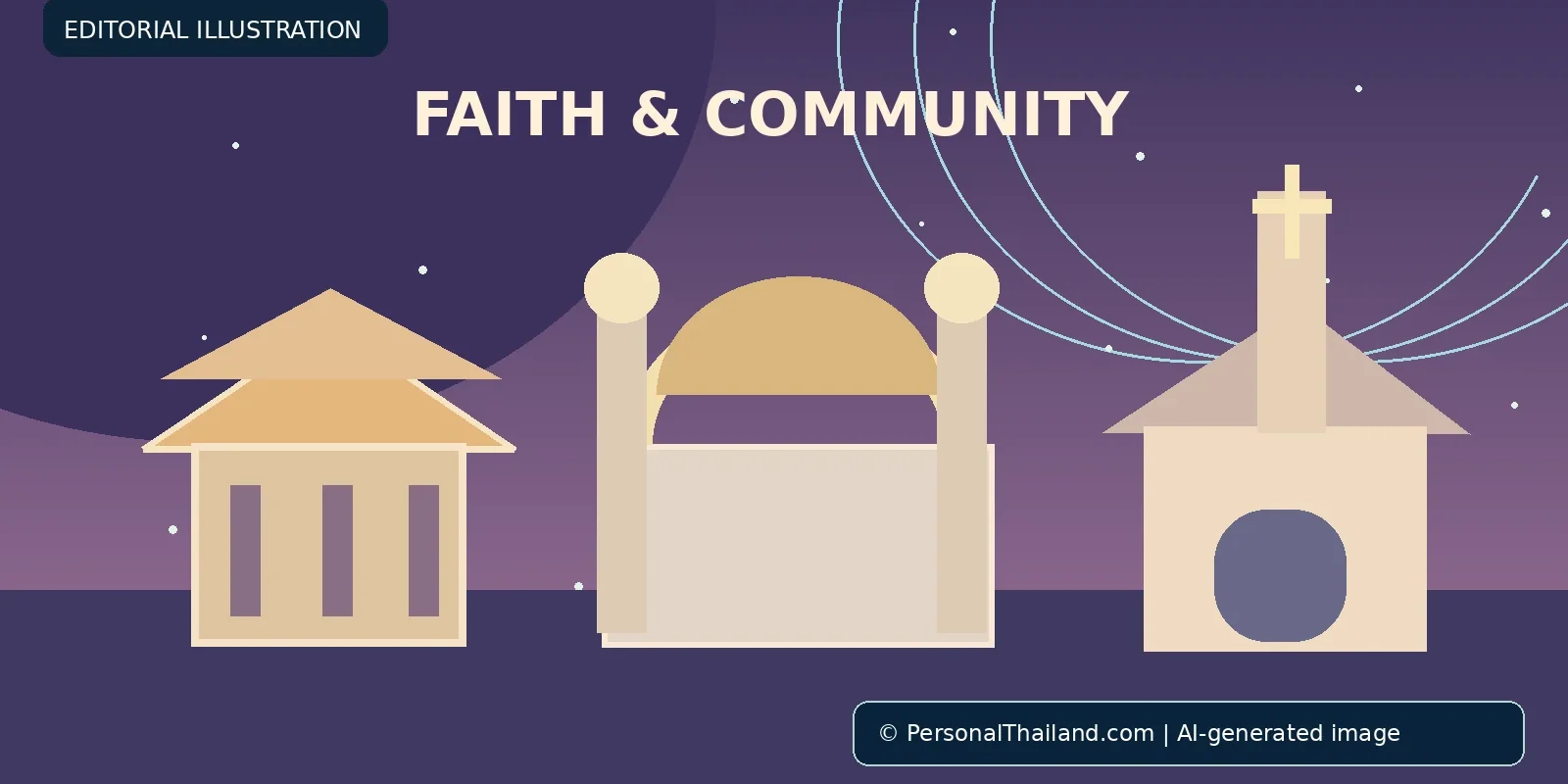
Visitors may first notice Buddhist temples, monk processions and offerings at spirit houses. Buddhism is central to much of Thailand’s public culture, but it is inaccurate to treat the entire population as one religion. Muslims, Christians, Hindus, Sikhs, Jews and people of other beliefs also live, work and worship in Thailand. Religious customs vary widely between Bangkok, northern provinces and the south.
An early version of this article, published in 2006, assumed that people of other faiths had few places to gather. That was a limited personal impression, not a reliable map of today’s religious communities. The better question is how to find the right group and visit it respectfully.
Buddhist practice and everyday life
Theravada Buddhist temples are a familiar feature of the landscape, and holidays or local celebrations often have religious elements. Many visitors enjoy learning about temple architecture, meditation or Buddhist art without themselves being Buddhist. A temple is still an active religious space, not simply a photography attraction.
Dress according to local notices, remove footwear where required and follow instructions for quiet areas. Avoid touching devotional objects and do not assume every temple welcomes visitors during ceremonies. The precise etiquette depends on the institution and occasion.
Christian churches and congregations
Bangkok has Catholic and Protestant congregations, and communities also exist in other towns. Worship services may be in Thai, English or another language, depending on the congregation and its members. Some churches serve expatriates as well as Thai families, while others primarily serve local parishioners.
When looking for a service, use the congregation’s current website or official contact details rather than an old blog listing. Ask about language, service time, whether visitors are welcome and any expectations around communion or participation. A church-based school or charity is not necessarily an open weekly worship venue.
Muslim communities and mosques
Islam is an important part of Thai life, particularly in several southern provinces, and there are Muslim neighbourhoods and mosques in Bangkok and elsewhere. Muslim travellers can ask hotels or local communities for the nearest mosque, prayer space or halal dining option. Availability and prayer arrangements are local matters, not things to infer from a whole province or district.
When entering a mosque, ask permission, dress modestly and respect prayer times. Some areas may be restricted to worshippers. A busy commercial street with halal restaurants does not automatically give a visitor unrestricted access to every nearby religious building.
Hindu, Sikh, Jewish and other traditions
Thailand’s urban communities include Hindu temples, Sikh gurdwaras and other places of worship. Some sites are associated with a specific community, language or calendar of festivals. A visitor interested in learning more can usually begin with the institution’s published information, a recognized community organisation or a respectful direct enquiry.
Do not assume that one set of customs covers all faiths. Head coverings, shoe removal, photography, food service and gender-specific spaces can differ. Watch what local members do and ask the host before participating in unfamiliar rituals.
Religious freedom and reliable information
The US Department of State’s archived 2023 International Religious Freedom Report documents recognized religious groups, demographic context and legal and social issues. It is a dated historical report, not an up-to-the-minute directory of places or a guarantee that every individual experiences religious freedom in the same way.
If legal status, visas for religious work or missionary activity are relevant to you, consult current Thai authorities and qualified advice. Private attendance at worship and organised religious employment or mission work can raise different requirements.
How to find a place to worship while travelling
Search for the institution’s full name, official domain and recent service announcements. Check that the location pin corresponds to an active congregation, not an old school or a moved organisation. If you need a service in a particular language, contact the organiser before travelling long distances.
When visiting smaller communities, ask about public access and whether donations are expected or entirely optional. Do not record children, congregants or ceremonies without permission. Religious practice should never be treated as a display put on for tourists.
Respectful faith travel checklist
Confirm the place and service time directly; dress conservatively when unsure; ask permission before taking pictures; observe rules for footwear and sacred spaces; and keep an open mind about practices different from your own. These small courtesies make meeting people easier than assuming a single faith represents Thailand.
For long-term residents, finding a congregation, interfaith network or community service group can be one part of settling into a new country. The important thing is to look for a community that actually meets your needs rather than relying on a twenty-year-old generalisation.
Official sources and further information
Check these official organisations for current information. Rules and contact procedures may change after this October 2026 update: