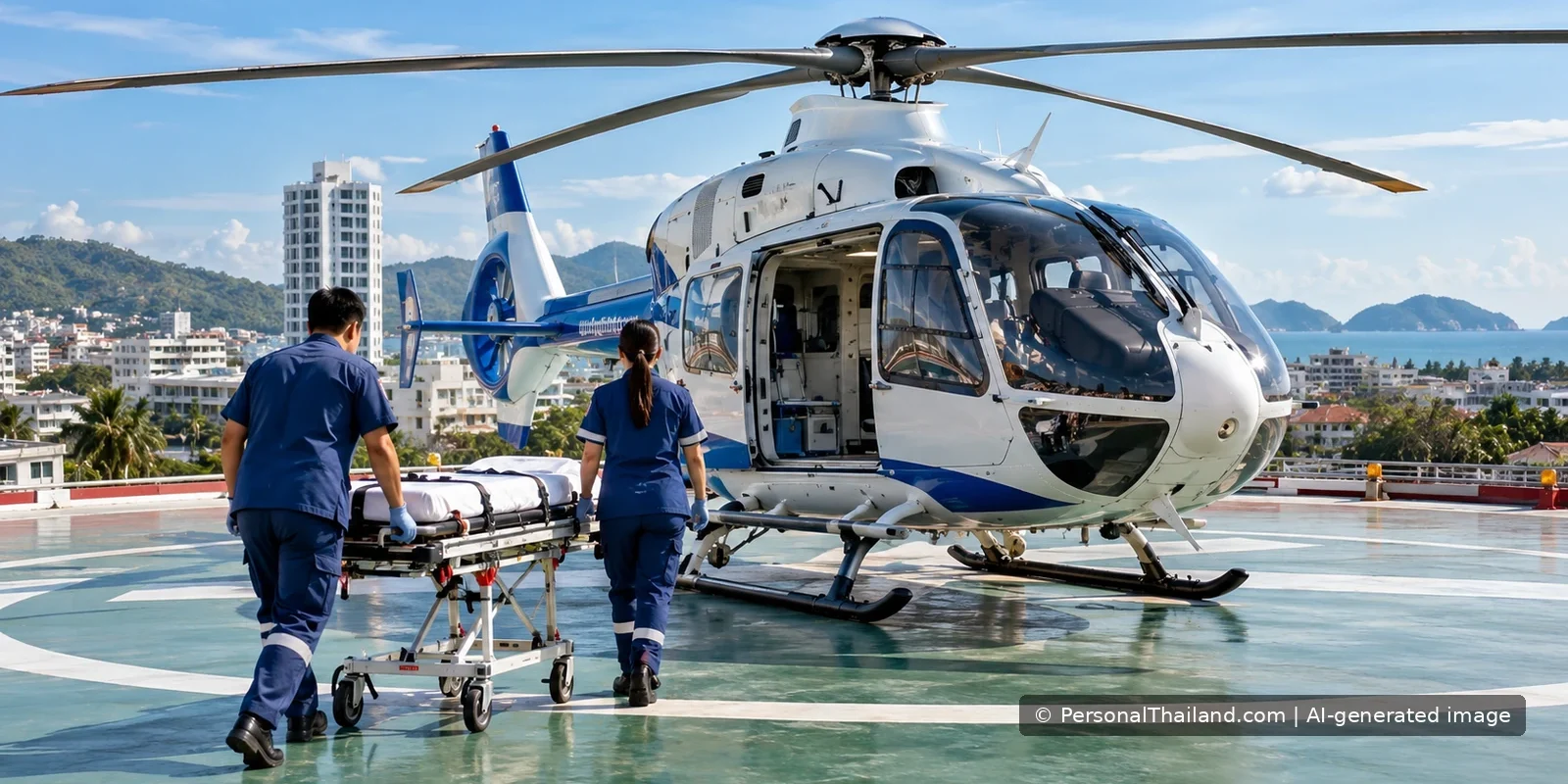
Thailand’s emergency medical network includes ground ambulances and, in selected situations, aircraft used for patient rescue or transfer. An old 2007 article on this website highlighted an expensive private helicopter service and compared its hourly price with the cost of buying a house. Those historical figures and the claim that one provider was the first in Southeast Asia cannot be confirmed from the original article alone.
The practical questions for patients and travellers are different: when is an air ambulance useful, who decides whether it is appropriate, and how can someone obtain emergency help without losing critical time?
What an air ambulance actually does
An air ambulance is an aircraft used to move a patient who requires medical assessment, monitoring or treatment during transport. The term can include specially equipped helicopters and fixed-wing aircraft, depending on distance, terrain, access and the patient’s condition.
Aircraft do not replace doctors, emergency departments or conventional ambulances. A helicopter may be faster in one setting but slower or impractical in another when flight permissions, landing arrangements, weather, equipment, patient preparation and ground transfers are considered.
The right transport method depends on clinical urgency and the available emergency response system, not on a patient’s ability to pay for the most impressive-looking vehicle.
Thailand’s Sky Doctor emergency referral programme
The Thai government’s Thai Sky Doctor programme overview explains that a national emergency air-patient referral initiative began in 2009 under the National Institute of Emergency Medicine (NIEM), with cooperation among public and private agencies.
The programme distinguishes two broad types of mission. A primary mission can involve helicopter emergency medical service reaching a patient before hospital arrival. A secondary mission concerns transfers from one hospital to another and can use different kinds of aircraft according to the task.
Air transport is particularly relevant where distance or geography makes conventional referral difficult, such as some remote mountain areas and islands. That does not mean every remote-area call will result in an aircraft dispatch. Decisions depend on clinical need, practical feasibility and operational availability.
What to do in a medical emergency in Thailand
For a serious emergency, call 1669, Thailand’s emergency medical services number. It is listed by both the Thai government and the UK government’s healthcare guidance for Thailand.
Tell the dispatcher where the patient is, what has happened, whether the person is breathing normally and whether there are immediate dangers. Give an exact hotel name, road, pier, landmark or coordinates if available, and follow the emergency operator’s instructions. Keep the phone accessible for a callback.
Do not delay calling emergency services while comparing private helicopter advertisements. The first response may be a ground ambulance or nearby clinical team, and those responders can determine whether a higher level of care or referral is necessary.
Situations in which air transfer may be considered
- Remote emergencies: an injured or critically ill person may be far from suitable hospital care and difficult to reach by road.
- Island or mountainous geography: ferries, mountain roads and weather can complicate the route to hospital.
- Interhospital referral: a patient may require a specialist service not available at the first hospital.
- Time-sensitive specialist care: clinicians may consider whether transferring to a more suitable facility offers a meaningful benefit.
These are examples, not automatic dispatch criteria. A transfer can be unsafe when the patient is not stabilized, the destination cannot receive them or weather makes flight hazardous. Medical teams have to balance those risks.
Private medical evacuation and insurance
Commercial medical evacuation is a separate arrangement from the public emergency response system. A private provider may offer domestic or international transfers, but the aircraft type, clinical staff, airport arrangements and total bill depend on the contract and the specific case.
Do not rely on the 2007 article’s helicopter purchase price, hourly charge or aircraft performance specifications. They are historic claims without verified current applicability. Request a written itemised estimate from a licensed provider if a non-emergency transfer is being considered.
Before travel, review medical insurance for emergency hospital care, transfers between facilities and repatriation. Check exclusions, authorisation requirements and whether the insurer chooses the provider. A policy that covers ambulance transport does not automatically guarantee a helicopter or an international air ambulance.
What if you are on an island or in a rural province?
Identify the nearest accessible clinic or hospital before an adventurous trip. Keep the accommodation address and local emergency contacts offline in case mobile data fails. If travelling with someone who has significant medical needs, discuss an individual plan with their treating clinician before departure.
For water activities, boat excursions and mountain trips, prevention also matters: use appropriate safety equipment, check weather advisories, carry necessary medicines and inform someone of the itinerary. Emergency aircraft cannot compensate for avoidable exposure or delayed reporting of an emergency.
The bottom line
Air ambulances are one part of a wider emergency-care system, not an on-demand alternative to ordinary medical assessment. Thailand’s official Sky Doctor programme offers a useful explanation of when air transport can play a role. In an emergency, contact 1669 promptly, share precise location details and let trained responders coordinate care.