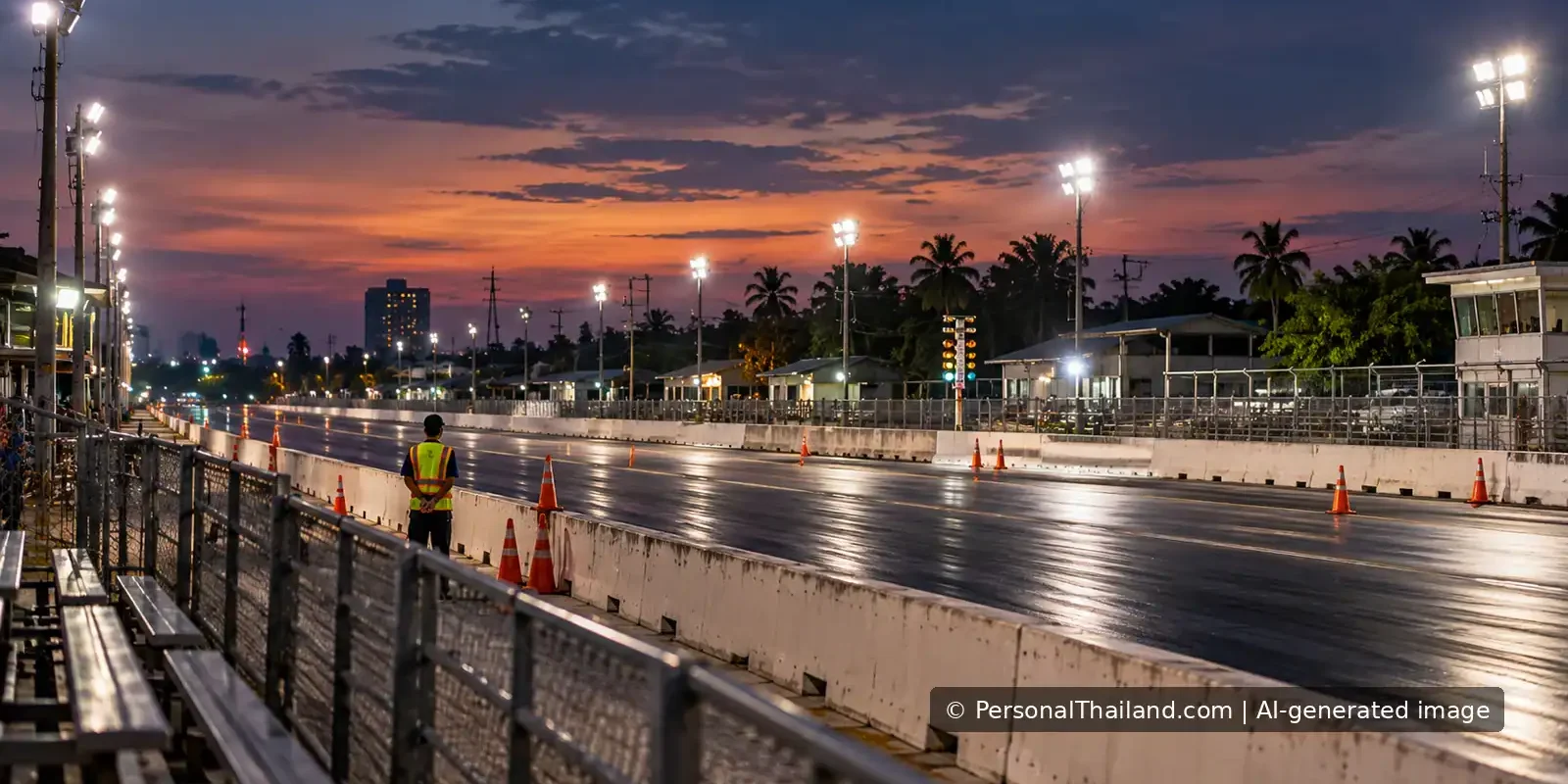
In late November 2008, Thailand was shaken by a motorsport accident in which a racing car went beyond a track barrier and struck spectators. A short PersonalThailand post reported nine deaths. Unlike many loosely sourced claims in old travel blogs, that figure is supported by contemporary news reports. The important distinction is the location and nature of the event: this was an organised drag-racing meeting, not evidence that ordinary roads in Bangkok were the scene of the same accident.
Remembering the incident should begin with the people who died and the families affected. It can also help explain why protecting spectators is a central part of any motorsport event, however exciting or familiar the venue may look.
What the contemporary reports confirm
An ABC News report carrying AFP coverage dated 24 November 2008 said nine spectators were killed when a racing car lost control after the start, crossed a barrier and struck a crowd at a track on the northern outskirts of Bangkok. Several other people, including the driver, were injured. The reporting attributed the account to a police officer at the scene.
A separate Swedish news report distributed by AFP and TT also recorded nine spectator deaths. Other contemporary sources identified the venue as Bangkok Drag Avenue in Pathum Thani province, north of the city. These sources support the basic event and death toll but do not, by themselves, establish the outcome of later legal proceedings.
Why location and wording matter
Bangkok is often used casually as the label for a much wider metropolitan area. For local safety reporting, precision matters. A track in Pathum Thani should not be described as an accident in Bangkok city traffic, nor should the incident be used to imply that all motorsport venues in Thailand operate with the same standards.
The event took place in November 2008. It must not be presented as a newly occurring crash. Archived coverage may say officials intended to investigate, suspend activity or bring a charge, but those are descriptions of steps under consideration at the time, not proof of the eventual result. Court outcomes require separate verification.
What barriers are supposed to achieve
A racing circuit separates vehicles from spectators through a combination of design choices, protective barriers, runoff zones, viewing distances and rules about where people may stand. A barrier is not an abstract reassurance; it must be suitable for the speeds, directions and vehicle types likely to occur at that section of track.
At a drag-racing event, acceleration starts immediately and the path from the starting area toward the audience needs careful consideration. The 2008 accident illustrates that losing control near a starting area can still be catastrophic. It does not establish which design or management decisions caused the failure; that question belongs to a thorough technical inquiry.
Safety questions spectators can ask
- Is the viewing area visibly separated from the competition surface?
- Are there clear instructions from trained staff and a designated emergency exit?
- Are spectators prevented from standing in unofficial gaps near a high-speed section?
- Do organisers provide visible information about first aid and emergency response?
- Does the event have an identifiable organiser and a published set of safety rules?
If you cannot see a safe designated place to watch, leaving is a reasonable decision. Never step onto a track, climb a barrier or enter an area set aside for officials. Even when activity appears paused, vehicles or recovery equipment may move unexpectedly.
Organiser responsibility goes beyond signs
Warnings alone cannot replace physical protection, sensible crowd capacity, safe entry routes and clear response procedures. Organisers need to consider what happens when something goes wrong, not merely how the competition is intended to run. Staff should be able to clear unsafe areas and communicate with emergency responders without confusion.
For fans, safety is not the opposite of enthusiasm. A well-managed event is more enjoyable when visitors can focus on the performance rather than wondering whether they are standing in the wrong place.
How to remember the 2008 tragedy responsibly
It is appropriate to document that nine people died, because the contemporary record supports it. It is not appropriate to turn their deaths into entertainment, invent a verdict or use the accident as evidence about every Thai driver. The durable lesson is that safety margins must be designed for unexpected loss of control.
For anyone attending a motorsport event today, the useful question is not whether a track resembles the one in a 2008 report. It is whether the current organiser can demonstrate safe spectator arrangements, clear access controls and responsible emergency planning.